

Colombia, unlike many other national cinemas, has yet to mythify its history through cinema. There is not a genre, style, or aesthetic throughout time that has been able to capture the chaotic, complex, yet compelling history of the country. The western, the gangster flick, even the procedural drama or the war movie, have all processed and rationalized trauma and violence, even of the worst kind, but none of those are prevalent in Colombian cinema. In the absence of any referent, there is always a first time for everything, in this case, Tomás Corredor’s first feature-length film, Noviembre. This co-production (Colombia, Mexico, Brazil, Norway), led by the Colombian director and scriptwriter, takes a stab at the colossal task of exploring, condensing, and mythifying one of the most crucial events of Colombia’s national history.
Using a singular bathroom as the set for the film, Noviembre follows the events that unfolded during the siege of the Justice Palace in the Colombian capital in November 1985. Purposefully leaving all the action happening off-screen, Corredor’s film focuses on the human interaction of the people trapped in the bathroom, particularly on guerrilla footsoldier Clara (a luminary Natalia Reyes), Supreme Court Justice Gaona (Santiago Alarcón) and guerrilla leader Almarales (Juan Parda). Functioning as a microcosm for the conflict itself, this bathroom becomes an arena where violence, politics, ideals, and morals will clash and contend with each other as the three characters begin to come to terms with the consequences of their actions. Corredor takes little time to contextualize the viewer with the intricacies of the war taking place at this time in Colombia. Instead, he uses archival footage intercut with the bathroom sequences to indicate the chronology of the siege. This proves perhaps challenging for a viewer who is not familiar with the intricacies of the event; however, it is an important narrative element of the film. Corredor is not concerned with the act of violence itself, but the principles, the circumstances, and the consequences of it.

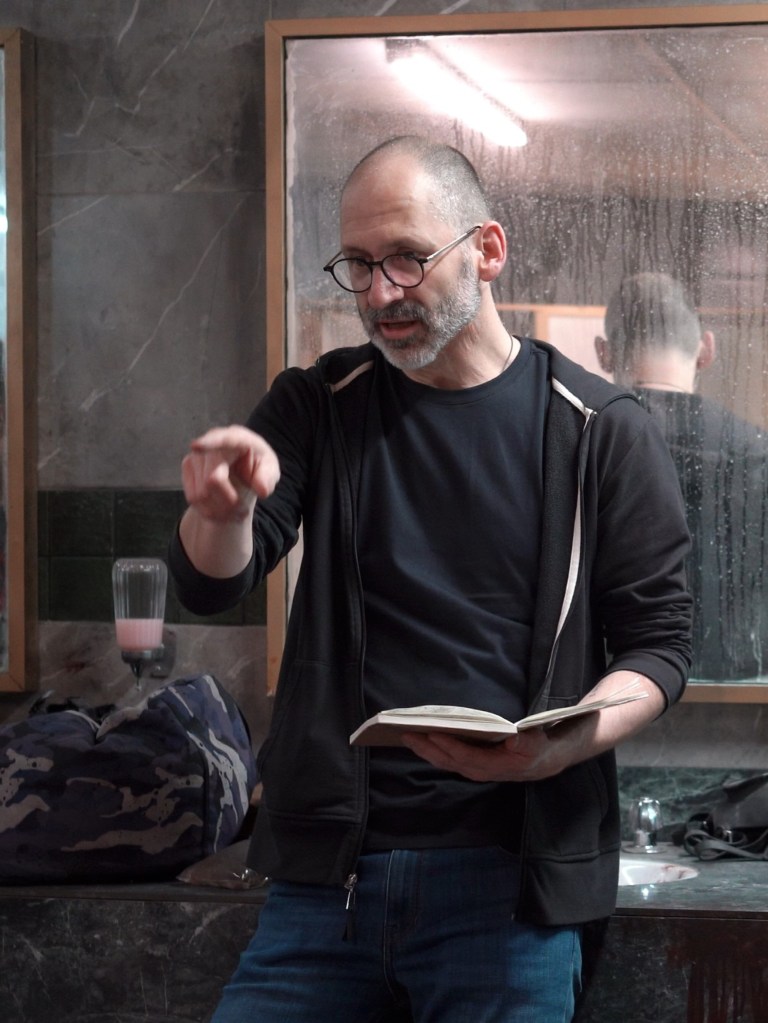
Ultimately, Noviembre embraces a humanism that is rare but refreshing, coming from a Colombian film. Corredor emphasizes the wounds and scars that war leaves and its consequences on memory, identity and a national psyche that is still in a state of commotion.
I had the privilege of speaking with director Tomás Corredor, DOP Carlos F. Rossini, Natalia Reyes, Juan Parda, and Santiago Alarcón during the premiere of their movie in Toronto on September 6, 2025.
Juan: What type of referent did you use to create a film that intertwines genre filmmaking and documentary modes?
Tomás: Noviembre is a film that really doesn’t have that many cinematic references. When I began writing about the siege, I had different points where I wanted something to happen, like in the bathroom, but I also wanted it to take place in the Council of Ministers of the Casa de Nariño, in the Casa del Florero, and in Reyes’ office. Little by little, I ended up with only the bathroom, and the first reference that appeared was Casa Tomada by Cortázar, like this presence of invaders that begins to arrive. I think it’s a film more of influences than of references, because I come from making three hundred commercials… That was my life before. I’m a bit weary of references, so I felt it was the moment to rely more on influences than references.
And at that point, the option arose of thinking about a film with a storytelling that doesn’t glorify the violence of war aesthetically, like through the explosion of a helicopter, the slow motion, the cocking of a weapon, but instead where all of that, in some way, is happening within frames where things look different. The approach was a little more philosophical. Noviembre does have a lot to do with how I look at humanity, with what matters to me at this moment. At this point in life, the world needs us to look at the people who are caught in the middle of crossfire, in the middle of war. Not just at how war looks. We’ve already seen plenty of that.
That decision meant that the bathroom was already a space sufficiently closed off to contain so many people, to the point where intimacy was lost. But I always wanted a film where it was very difficult to be alone. Part of that loss of intimacy had a lot to do with always being seen by someone else, or feeling the presence of another person in the frame, always around whoever was in the center of the frame, and things like that. Then it automatically became a different kind of film, because of the basic resources of cinematic grammar. I avoided the thought of: “If I’m doing this, cut closer. If there’s a tear, cut closer”. Instead, we worked with a different grammar, using much wider shots. And I think that’s where a major difference emerged, because it’s a film that truly breathes from a collective perspective. That’s where the difference lies, which I think works, and that’s where the “references” come in. It’s a project that feels more based on the people than on how war looks. And when I talk about the philosophical side, it’s closer to a kind of panopticon, like Sartre’s No Exit, for example, where people can’t blink and everyone has to see everyone else.
Juan: Given the fact that the film takes place in only one location, how did you find the dynamism the movie needed?
Natalia: The truth is, it was indeed a small space, even though it was carefully designed so the shoot could technically work. Still, the sense of confinement was very present, and for me, that became part of the acting process. It carried this feeling of being trapped, the feeling of desperation, of hopelessness, of having no way out.
It was also a very intense experience living closely with the cast. There were quite a few of us, along with the technical crew. But what made the shoot so special for me personally was the level of intimacy and togetherness that grew over that month. There was a real spirit of camaraderie, but also a deep respect for what we were portraying. I felt that throughout the process, we were constantly aware of what we were doing, beyond just the mechanics of filming. It was about asking ourselves what story we were telling and why. I believe there was a strong sense of connection among us. That ultimately we were there to honour the victims. This project went beyond the vanity of simply telling a story or bringing it to Toronto; it came from a genuine need.
As Tomás says, it was something very personal: a need to revisit a historical moment in Colombia that we’ve always struggled to confront. Even today, it remains controversial, something people don’t want to talk about because it’s politically uncomfortable, tied to many parties. Yet I think we all felt that a sense of courage was needed, paired with the awareness that we weren’t approaching it from any political position, but from a profound sense of humanity. We were creating a small piece of memory, and at the same time, a tribute to those who lost their lives there.
Santiago: I think one of the fundamental moments of the film was during the casting, because the setup is very theatrical, right? Since most of the actors come from theatre, the spirit of collective work, teamwork, and collaborative creation was already there. We all understood the codes once we grasped what the film was about. For example, at which moment was it when one character needed to take the spotlight or when another did. When we had to support, when we had to act as a chorus, and when we had to be protagonists. I actually only found out yesterday that I was the protagonist. An actual protagonist of the film! [laughs] But I think the vision that Tomás and Manolo (acting coach) brought to the film helped tremendously. Together, we managed to fuse as a team, to really believe in what we were doing.
The whole process of living together became part of the performance. Coexistence itself was like a staging exercise, because every day we would talk. Of course, there were about thirty of us in the bathroom. Thirty! So sometimes we had to create these small micro-scenes among ourselves. Like, “Hey, let’s add this here, let’s try that,” because maybe the shot was on Almarales. Then we’d ask, “Okay, how can we support Almarales so that it works? How can we give him another angle, another focus?” It was a completely collective effort, the kind of thing you’d call collective creation, all guided, of course, by Tomás.
Tomás: There’s something I find very important, which has to do with the camerawork, and this is closely tied to what I mentioned earlier about the representational device with the actors. I wasn’t just in one location. It was in a single set, which is totally different! A set is even more reduced than a large location with multiple settings. Here, we had a single set. That set needed to become a protagonist of the film.
When you have a group of people confined in a space like that, the space itself has to act. Otherwise, the actors end up having to explain a whole series of things that the space could already convey. The space speaks of decay, of degradation, of the accumulation of dirt. This reflects, in parallel, the emotional state of the people inside it. That’s why it was so important to me that, when we returned to wide shots, the actors and the space became one and the same. The space itself could have been credited as one of the thirty characters. It was important that, in our shots, we could actually see everything wearing down, falling apart, dissolving over time.
There’s a beautiful book called The Cultural History of Pain, which philosophically explores the forensic idea that corpses don’t lie. Before an investigation, people can offer endless versions, explanations, and narratives. But the body doesn’t lie. For me, the same is true of space: it doesn’t lie. Even if people find ways to protect themselves in that lack of intimacy, for example, by putting on a stern face, turning away, or refusing to speak, the space does not lie. So I felt the set itself was a kind of support for the whole acting device. Giving the bathroom a leading role was essential. And that’s directly tied to the choice of shots.
Carlos: I came on board when the film was already in an almost finished stage of development. In our first conversation, we talked more about philosophy than about imagery. That’s how we started: our first exchange was political, philosophical, and human. What drew me to the film, and to working with the actors, was precisely this idea of asking myself: what can I contribute, where do I come from, and how does that matter here? It relates to how stories are often told in cinema, not just in Latin American cinema, but in film more broadly, where history and period pieces are usually anchored to very concrete places, events, and objects.
Also, what struck me about this project was the setting of the bathroom and the idea of shifting the historical weight toward generating many extremely subjective points of view. That feels aligned with how history itself is being portrayed in many other arts, and here the film does it beautifully. It strips away the historical price of narrating delicate events. It’s far more interesting to sense, to perceive through the performances, how the actors embody the experience of confronting the historical moment, rather than simply asking: what happened, who was on which side, why were they there?
With the camera, we stayed frontally the entire time. At moments, I pushed to go even further, to confront history more directly, and to turn it into both story and History. That shift changes everything: the relationship to optics, to space, to how we compress space when needed, or how we compress the gaze. For me, this subjective gaze needed to reveal what it sees, or the uncertainty of how it sees. That uncertainty tells the real moment. As a cinematographer, that’s a wonderful playground. A chance to keep exercising and pushing further, beyond the physical challenges of how to light, how to move, how to make it all work. The real challenge was engaging with so much raw material: so many actors, so much direction, the richness of costume work. The set design was by a close collaborator of mine, Nohemí González, an incredible production designer. Working with people like her allowed us to make the most of every moment. We talked a lot about lenses, refining which one was right for which situation. We didn’t switch too often. On the second day, I said, “Oh man, I really need a 28 and a 40!” [laughs]. Sure, the 35 worked, the 50 worked—but that 28 and 40 changed everything, especially given the challenge.
Tomás: Sorry to interrupt, especially about the challenge of showing our movie in 4:3. Knowing that we were going to end up in 4:3 was complicated, because everything had to fit within that proportion to work.
Carlos: Yes, because there’s also a relationship between who is standing against the background or with the other people. You can compress or shorten that with a lens. By simply changing a lens, you change the rhythm of a film. Of course. So for me, it was both very intense and very enjoyable. I felt incredibly supported.
Juan: We are very familiar with the images of this event and with violent images in Colombia. Is there a correlation with the fact that all of your establishing shots are archival footage shots? Is there a connection between your producer, Diana Bustamante and her movie Nuestra Película (2023) and the archival footage you use?
Tomás: There’s a key element in what you’re saying, which is that this film has no establishing shots within the fiction itself. For me, that was one of the rules. Establishing shots give the audience a certain comfort, helping them understand the space where the action unfolds. I deliberately didn’t want that. Part of the discomfort of watching the film is having to figure out, for quite a while, how to orient yourself in that place as a spectator. For me, that’s very important to emphasize.
The film was cut down a lot. The version that is about to premiere today is very different from the one that was written and shot. There were many narrative paths, where a character would start to gain protagonism through a small action here or there. But when we saw the edit, it became clear that no one could really be more important than anyone else. There are key points of view, of course, but as Carlos was saying, just as a lens can change the rhythm, following a side story could break the rhythm of the group. So we leaned toward making a much more compact narrative, centred on events that involved all the characters, rather than scattering into small stories everywhere. The small stories are still there, because they’re part of the film, but they’re not the driving force.
Now, about the archive material. Originally, the film wasn’t going to have any. What happened is that Felipe Guerrero, the first editor of the film, sent us one of his early cuts with a proposal for a prologue with archival material. He said: “As a Colombian watching the film, I understand it and I know what I’m seeing. But this film should include archive footage.” I told him I liked the idea, but that we should use it within the film itself, as a way of marking time. Then Diana, who has become someone incredibly rigorous, studying archival material and understanding it as a kind of plastic element, at first was afraid of the association with her film Nuestra Película. But at some point, you have to let go of that fear, because this is another film, another search. We were careful with some material that was too damaged, some was interesting, but visually too close to Nuestra Película. Instead, the effort was to find the least-known footage we could, material that allowed us to create connections.
I keep insisting: the film is about humanity. Just as we show soldiers sleeping or people exhausted inside the bathroom, it was about linking what happens inside with what happens outside. Moving from a shot of someone suffering a loss inside the bathroom to soldiers outside. Faces confronting faces. It was about humanizing everything as much as possible, not taking sides. The film’s positions are clear, and when you watch it, you feel things, but it’s not about dictating who was right or wrong, who did well or badly.
Juan: How do you historize the Colombian ethos in your film?
Tomás: I would say that memory and history are very different, because memory is not always about the past. In films, memory is a politically contested territory, and everyone is narrating their own version of memory from a position of power. When we try to create a project like this, we have nothing to negotiate with the positions of power that dictate history. We’re making a film that proposes to them a real exercise in memory, from a human perspective.
The first thing any screenwriting class teaches is that a script is written in the present tense. I’ve always understood that as: these are actions that, each time someone watches the film, gain a new significance. I don’t write in the present so that the events will literally repeat every time you watch the film. Instead, each viewing is an exercise in memory, a conversation about the same subject. This allows viewers to reflect differently each time and grow in their understanding of memory.
I think that’s the real contribution of this work. What is the message of a film? I don’t believe in films delivering messages. I think instead about what a film says about humanity, about resilience, about dignity. I don’t believe there’s a “good war” where someone can win fairly. No one wins; everyone fails. It’s all a huge mistake. It’s a testament to human stupidity on a massive scale.
But beyond that, for me, this film is not only about Colombians; it forces us to look elsewhere at where people are in war. The latest report from the Colombian Truth Commission, a few years ago, noted that more than ninety percent of deaths in the conflict were civilians. And yet we continue to see war only as a conflict between those firing weapons, rather than considering those caught in the crossfire. To me, that’s the ethical proposal of the film: to be with the people, to focus on humanity.
Carlos: This is also something carefully developed in the cinematic approach about how we work with the camera, the direction, and the performers, so to speak. Throughout, there’s a commitment to the intellectual maturity of the viewer. The film is never didactic. You’ll notice that the entire film is structured around what you don’t see. There’s always an off-screen presence. We limit the viewer’s access and start cutting out people, because the brain has to begin proposing solutions on its own. It’s about cultivating a certain maturity in the audience. This is something I find lacking in much contemporary cinema. I feel cinema has regressed in that way. Lately, cinema tends to be didactic, overly explanatory. This film does the opposite. Noviembre bets on the viewer’s maturity, trusting that each person will reflect from their own position. There is no alternative, no way around it. It aligns closely with what Tomás says. It’s like saying, “Here’s what we’re giving you; now it’s on you.” We offer what we can, based on everything we do together on set.
We share that work from a place where everyone is contributing their ideas, their philosophical, political, and human perspectives. And through the camera, we try to approach what no longer exists, to engage with it respectfully, and to share that experience with the audience.
Juan: It seems that in Colombia, we have a terrible collective memory, perhaps as a defence mechanism. There is a scene in the film where we see the characters burning their IDs and personal pictures, trying not to be recognized or remembered. How did you explore the idea of national/personal identity and memory in the film?
Tomás: Colombian history is very violent. This is one of the moments in my research that made it to the film nearly untouched. There is a point where certain traces are erased, where you have to disappear so that nothing happens to those around you, so that nothing happens to those who survive in a country where someone like that will end up disappearing anyway.
There are two counterpoints in the film. The moment when the documents that identify people are lost, when memories shared with their families are lost, when a little scrap of paper written years ago is lost. Conversely, when someone writes something on a wall. Leaving behind some trace, a written memory, because you know you’re going to die, or erasing everything you are because you know you’re going to die.
I don’t want to talk too much about specific scenes, so as not to spoil the experience for someone who will watch the film. But it has to do with this: I kept telling the entire cast that it’s very hard to approach this film through the characters’ backstories. There was no traffic of information about the characters’ pasts because, when you’re living through an extreme situation like this, many things about who you are in life matter very little, if at all. In that resistance, in that struggle to survive, we worked very much with the characters’ present. And at a moment of imminent death, one of the possible reactions is to disappear to protect those who will remain.
Carlos: And this is a shared history in all of Latin America. It’s brutal.
Juan: Each of the three main characters represents a pillar or a facet of Colombian society. How was the process of developing their relationship?
Natalia: I think the same social dynamic that existed on set likely mirrors the dynamic that played out in reality, in that moment of history. At first, everyone carries a mask, a title, a category. If you’re a soldier, you’re wearing a uniform. If not, you’re a guerrilla fighter, wearing a different uniform. Or you’re a civilian, dressed as such. The film starts by showing this very clearly: two literal sides, separated in the corners of the bathroom. But just as it happened during that month of shooting, among the actors and the characters, this division starts to dissolve. People begin to coexist, to humanize each other, to empathize with each other, realizing that in the end, we’re all in the same situation, albeit for different reasons, with different uniforms.
I think that’s the most interesting aspect of the film. It goes beyond political positions while clearly showing that mistakes were made by everyone, by all sides. This entire event was, in many ways, a massive failure involving many parties. But ultimately, what existed was a large group of human beings confined to a space, trying to understand what was happening to survive. That’s the struggle of humanity: survival, beyond an uniform. That’s what makes it compelling. In the end, these three characters, these three pillars, these three segments of society, are in the same bathroom, enduring the same conditions. All three have families; all three want to get out alive; all three are suffering due to their own decisions and the decisions of others.
Juan Parda: Yes, I also think there’s something important about working as an actor in a confined space. Theatre training really helped in understanding the impulses and dynamics that later emerge on set. The rehearsals were extremely useful for grasping this dynamic and for understanding how these three pillars, or these three characters, interact, especially at moments when they contrast with each other. This happens a lot, particularly with the characters of Gaona and Almarales, who are, at certain points, antagonistic. Both are very clear in their positions, while Clara is in the middle, almost like a thermometer, moving from a position closer to Almarales to the other side. Her arc reflects an ideological and personal shift in alignment as circumstances evolve.
Physically, this was also happening on set, right? Because we filmed in real time, the situation was deteriorating as the shoot progressed—the communal experience inside the bathroom became more challenging. We were becoming closer as friends outside, but inside the set, tensions were rising.
Tomás: But there’s one thing about what you’re saying that I find extremely important: the way the film was rehearsed. The film wasn’t rehearsed scene by scene with camera shots in mind. During rehearsals, we worked in blocks, scene by scene, and I would take photos through my viewfinder to frame some ideas and proposals.
I come from a background in advertising, where everything is storyboarded: shot by shot, drawn, exact. But when I arrived on set, the set itself showed me that the film had to be a bit more like what it is now. That began a different process. Everyone was like, “Which shot comes next? Let’s set up here, let’s do that,” and we started living it, coordinating it, and doing it in a way where, yes, we had rough drawings of the next shot, but the exercise was much freer because of this acting dynamic. If we had gone strictly by the storyboard, we would have removed a lot of the soul from the film.
I’m not saying that rigour isn’t necessary. What I mean is that you also have to let the film speak for itself. If you want to do something different, even if that wasn’t the original intention, you have to let the film guide you. I don’t think the film ended up different because I wanted it to be different. But if you want your vision of an event, of humanity, to prevail through the final cut, you have to allow the film to communicate with you. If you impose only what you know, reducing it to shots, action, and cuts, you lose the emotional freedom, which was what really mattered to me in this film.
Juan Parda: Those stimuli were very precise, very specific. For acting, they felt very real in relation to what we can imagine of the situation, twenty-seven, twenty-eight hours locked in a bathroom, cramped in those conditions. We would spend our time on set, much of it inside the bathroom, in similar conditions. Obviously, there was a safe distance, but we could still feel the heat of the lights, the air, and even the gases.
Carlos: There’s something in what you’re saying that, for me, was one of the best things about joining an already established film: it’s a living film. I always have this concern when I arrive on a project that’s already written, but this film was written to be discovered through the dynamics on set. That kept all of us in a state of constant creation, always searching for details, for the randomness of life. We talked a lot about life’s random moments, about how things emerge naturally to sustain the story. We said, “We don’t want this to be a Google Maps of history; we want it to be something you can truly move through, experience, and inhabit mentally.”
Tomás: A dynamic began to emerge where everything started to resemble what we truly wanted it to be. This was precisely because of the constant collective process, almost a month of rehearsals and a month of shooting. I think this film is shot from emotion. It carries a deep love for what happened and a profound respect for those events.
Santiago: Precisely for that reason, what really happened, those six weeks of rehearsals, four in Colombia and two in Mexico, was so crucial. I remember Tomás saying that what he wanted least during shooting was to rehearse. The idea was that all that rehearsal work we had already done would carry us through the filming.
It was fundamental not just for constructing the film, but also for building the characters. The characters were developed right there, in those relationships. As Tomás said, we’re dealing with a magistrate of the court, Almarales, or Clara. But what happens to them when they stop being magistrates, when the commander’s authority disappears, when all the labels fall away? They become just citizens, each with their own convictions, each ultimately trying to survive. The labels no longer matter. What matters is life. It’s about how to get out alive. Each character has lost in their own way; each has tried to do the best they could. In Gaona’s case, he’s always tried to navigate a better way out, despite the stubbornness of some and the desires of others. And in the end, everyone loses.
Tomás: It’s truly exciting that there’s a vision, let’s say we all agreed on it before we started [laugh]. Not only the vision of what the film means, but also, when we talk about the process, considering it from different perspectives, I think that’s really interesting.
Natalia: There’s a technical aspect that just came to mind, and it’s first the fact that we shot the film chronologically. That was very important for us, especially since we were really experiencing the story day by day, through both the shoot and the rehearsals. Obviously, the film isn’t a single long take, but in a way, the rehearsals almost were. They were like a full play. We first staged it as a theatre production, in a theatrical space, developing the characters from beginning to end. What we did during rehearsals was run through the film from start to finish. After many weeks of rehearsal, we were ready to shoot the film from beginning to end, and then we filmed it over the course of a month. That exercise in acting was also incredibly valuable and interesting.
Carlos: Yes, it allowed us to see the full arc of the film, which is an incredibly complex matter, how ethical positions hold up against the intensity of reality. That was very exciting for me. It was important to be able to see it live, across the entire arc. And it was incredible to watch how it begins to crumble: first ideology, then ethics, morality, and in the end, only the bare bones remain.
 Short Ends