

Winner for Best Cinematography (Alex Metcalf, dir. Alberto Sciamma) in Fantasia’s Cheval Noir Competition.
There is a certain fatigue that comes when attending a film festival. Three movies a day, for a couple of weeks, are enough to exhaust even an avid cinephile. After some time, films start meshing together, images melt into each other, and stories drown in a puddle. However, now and then, there is a movie that comes and shines through the crowd. A film that talks and relates to you in such a personal way that its images and sounds are immediately engraved in your mind. Such is the case for Alberto Sciamma’s film Cielo (United Kingdom, Bolivia). With a keen eye to detail and a tenderness that exudes from the screen, Cielo tells the story of Santa (Fernanda Gutiérrez Aranda), a Bolivian indigenous girl, as she journeys through the Andean landscape in search of a promise, a saving grace, a solace: heaven. Through her path, she encounters a series of colourful characters that are infected by the little girl’s outlook on life and her sense of magic. A priest, a cop, and a Luchadora (woman wrestler) are touched by Santa’s presence, by her melancholic yet inspiring tale, by her musicality and vibrancy. The Spanish director shapes and captures an iconography that was just waiting to be discovered. With respect, admiration, and palpable love, Cielo comes into dialogue with magical realism, spirituality, and nature.

I had the privilege of interviewing Alberto Sciamma during this year’s edition of Fantasia International Film Festival. This is how our conversation went:
Juan: How would you categorize Cielo? What genre is it? How would you describe it in a few words?
Alberto: Well, when I wrote the first draft, at no point did I stop to think, “What is this movie?” Sometimes you write targeted projects, for example, when horror is selling well, you might choose to do something like that. But this time, I tried to let go of that notion. Cielo was hard to classify. I didn’t think, “This is going to be fantasy” or “This is magical realism.” I had no final plan. I wrote it as a stream of consciousness.
I was in Berlin marketing my previous film, I Love My Man, a pure comedy, just because I wanted to write something funny. There, I visited Jon Dunton-Downer (executive producer for Cielo) and his wife Ana María Vera, a classical pianist from Bolivia. They asked me what I wanted to do next. At that moment, I didn’t know, but I had two images in my head. One was of a girl swallowing a fish. The other was a girl pulling a cart with a barrel through the desert. Just two images. No story yet.
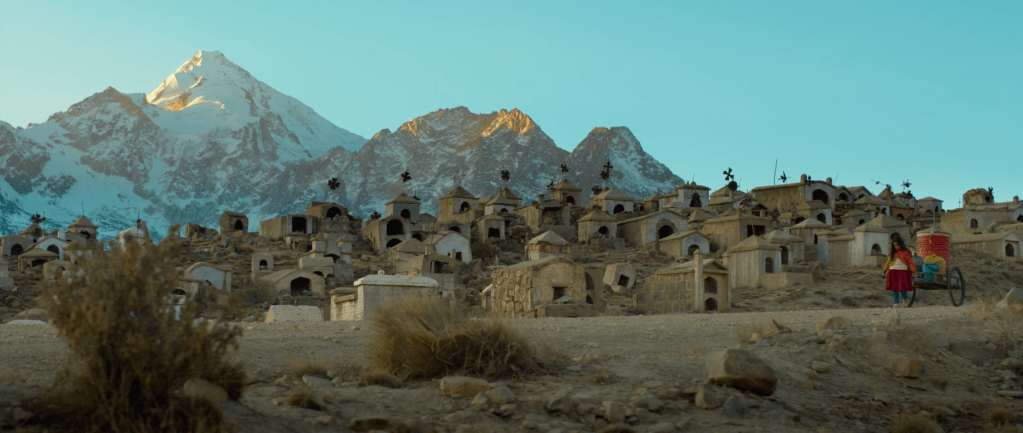
Ana María then pointed me to Bolivia. I had never been to Bolivia, but she had lived there. In Europe, people don’t have mental images of Bolivia like they do for Brazil or Mexico. Bolivia is largely unknown. The pictures Ana María showed me were stunning, and I was deeply moved by the landscape. That was six or seven years ago. From there, I started forming ideas. Eventually, after talking to people in Bolivia and doing research, I started writing with Bolivia in mind. Again, stream of consciousness. I didn’t know where it was going. So, it’s very hard for me to classify the film. It’s not easily placed into a genre.
J: After finding the location and forming a clearer sense of what the film would be, how did you develop or discover the visual language you would use?
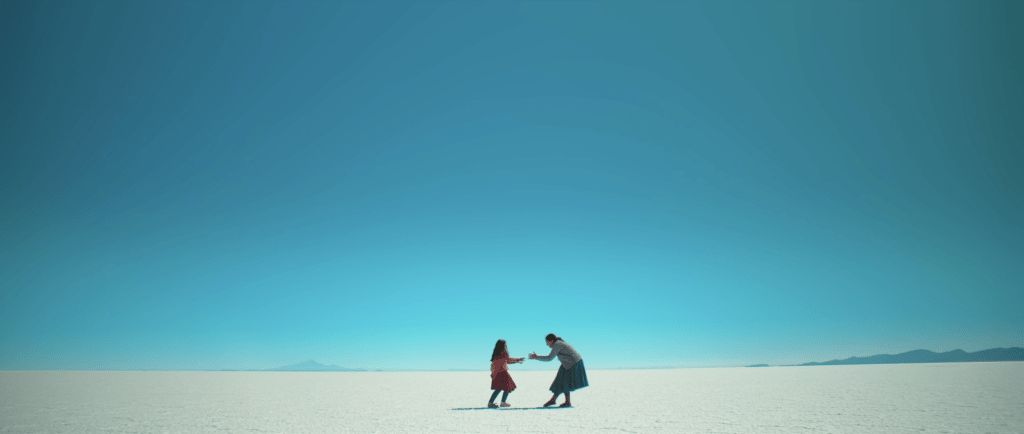
A: The only gringos in this film were the cinematographer, some producers, and me. Everyone else, from the poster to the music, was Bolivian. The visual language developed over years of conversations, talking to everyone and slowly understanding what Bolivia could offer visually, which was a lot. I realized that Bolivia’s landscapes, the valleys, the mountains, and the Salar de Uyuni don’t lend themselves to shooting with hundreds of cuts. These are meditative places. When you’re in the middle of the desert, not the Altiplano so much, but the desert, there’s no sound. No insects. Nothing. You’re in a spiritual space, in a sense. So, after many conversations with the cinematographer, we tried to encapsulate that visual plasticity Bolivia offers.
J: Since we’re talking about Bolivia, how did you merge the Bolivian identity with such a universal story?
A: I think that was relatively easy in the sense that the core of folklore, any folklore, not just Bolivian, is universal. Everyone, no matter where they’re from, looks up at the stars and wonders: Why am I here? Everyone feels rooted and simultaneously wants to escape and find a better place. But the film, I think, adapted itself, or rather, we all adapted the film together. The Bolivian actors, the landscapes, everyone involved, we shaped the film like clay. Everything blended so organically that it’s hard to distinguish one element from another. I worked in Bolivia not by imposing a foreign vision, but by adapting myself to the landscapes, the actors, and the culture. So, no, that fusion wasn’t difficult. The universal is already embedded in their stories.
J: How was the process working with the actors and the dialogue? Was that something that evolved during production?
A: Yes. Of course, I had a script, drafts and drafts of it. But I was lucky this time to have time for rehearsals, which often isn’t the case. I worked closely with all the main actors in rehearsals, discovering what they brought to the table, how they worked. I adapted the script to them. For instance, the character of Reina (Sasha Salaverry) in the script was originally more intense, more assertive. But when I saw the tenderness she brought and the connection she had with Fernanda, I started changing the tone and the dialogue. I kept the same scenes, but adapted them to their dynamic and emotional range.
J: And how did you go about casting Sasha and Fernanda, the two leads? Especially Fernanda, who was such a discovery.
A: Well, I’ll tell you two very different stories.
Sasha, I casted because I had seen her in two short films. One was very stylized, with her playing a high-society woman. But even with all the layers of makeup and costume, her performance had an internal depth that stood out. The other short was more realistic, almost documentary-like, and she still carried it beautifully. We started talking online during COVID, just getting to know each other. I told her I didn’t want to offer her a role without knowing each other a bit better. Then, after many conversations and some in-person meetings, I rewrote Reina for Sasha. Her background, her sensitivity, her tenderness—they all shaped Reina.
Now, Fernanda was a casting miracle. We spent a long time casting. We knew from the start that the film depended on this little girl. If she didn’t work, the whole film would collapse. We couldn’t just hire a trained child actor. We didn’t want a precocious, overly theatrical child. We wanted someone real, who could carry the film with subtlety. So we travelled all over Bolivia, La Paz, El Alto, Santa Cruz, Tarija, Sucre, Cochabamba… schools, neighbourhoods, cultural centers, wherever we could find kids. We interviewed hundreds. Fernanda showed up at the very end. She had heard about the casting and sent a video in; she was really funny and charismatic. When she came in, we did a chemistry test with Sasha. And right away, I said, This is it! This is Santa. Not just because of how she acted, but because she understood the story. She connected with it emotionally. Sasha and her had this incredible, unspoken bond.

J: Were there any moments on set, especially between those two actors, that shifted your vision of the film?
A: All the time. Every day. I remember a scene we filmed near the end of the shoot. It was a night scene, very emotional. We had rehearsed it, but something was missing. So, I told Fernanda to forget the lines and follow her feelings. She looked at her and said something completely unexpected, but so beautiful and moving. We were all in tears. The scene made it into the final cut. That scene wasn’t me; that was all Fernanda’s. There were many moments like that, little miracles. And I think that’s what cinema should be. It’s not about controlling everything. It’s about listening, adapting, and letting yourself be surprised.
J: That really comes through in the film! The feeling of a deeply collaborative process. At times, it almost feels like a collective dream.
A: Yes. That’s something very important to me. Even though I’m the writer and director, I never want to feel like I’m the sole author of the film. The story and images only came to life because of what everyone brought: actors, crew, musicians, designers, everyone. I see filmmaking as a living process. It’s not just about executing a vision, but about discovering the film together. I also worked a lot with the editor, Pablo. We weren’t just assembling scenes, we were discovering the rhythm, the emotional current, the dreamlike logic. It was like sculpting.
There’s a part of the film where everything becomes more fluid, almost like water, and we wanted the edit to reflect that.
J: Was that dreamlike structure already in the script? Or did it evolve more in the editing?
A: It was there in the script, yes. I don’t write in a very linear or conventional way. I tend to write with images, rhythms, and emotional arcs more than plot. But editing allowed us to deepen that feeling. For instance, we played a lot with ellipses, with what we don’t see, with what’s left unsaid. There are narrative holes, and that’s deliberate. I think cinema becomes powerful when it invites the viewer to fill in those gaps, to dream a little. We were always asking ourselves: What can we remove without losing the soul of the film? Sometimes silence says more than dialogue.
J: There’s one moment I found especially striking in that sense: the ending scene when the main characters dance. It feels like a rupture in the narrative logic, but also like a culmination. It’s raw, unfiltered, almost mythical.
A: Yes. That moment was very delicate to place. In the script, it was in a different spot. But as we edited, we kept moving it around, until we found the place where it felt most like a release, a breaking open of emotion. The dance was choreographed six months before we shot it. We were trying different things to match the lyrics of the song, which was written specially for the movie. It became a kind of lullaby, a lament, a prayer. And in the final version, we let the camera linger. No cuts, no tricks. That scene scares some people. But for me, it’s the heart of the film.
J: What were the biggest risks or fears you had making this film?
A: So many. First of all, I didn’t know if the film would work. It’s not a conventional story, and I didn’t know how people would receive it. There were days on set when I’d ask myself What am I doing? Is this going to make sense? But then I’d look around and see everyone giving their all, believing in the project, and that gave me strength. Another big fear was that, as an outsider (not Bolivian), I might get something wrong. I didn’t want to exoticize or misrepresent the culture.
That’s why I spent years listening, learning, asking questions, being present, not just parachuting in with a script. I worked with local consultants. I spent time in communities. I tried to earn people’s trust. In the end, I think the film reflects that care. I’m not trying to explain Bolivia. It’s just a story that happens to take place there.
J: And how has the reception been in Bolivia?
A: Honestly, it’s been beautiful. When we screened the film there, I was nervous. I thought people might say, “This isn’t our story,” or “Why did you tell it this way?”
But instead, people came up to me and said things like, “That’s how it feels to live here,” or “I saw my mother in Reina.” It’s made me think a lot about how stories travel, how something born from personal images and feelings can resonate across borders.
J: Finally, what do you hope viewers carry with them after watching the film?
A: I don’t want to tell people what to feel. But if they leave with a sense of tenderness, or if they remember a dream they once had, or think of their mother, or feel a bit more open to the unknown, that’s enough. I think there’s too much noise in the world. Too much certainty. This film is an invitation to listen to silence. To remember that sometimes, what’s invisible is the most powerful.
 Short Ends