

As an outsider it is rare to have been present since the inception of a film, that is why I knew Fleurs Secheés was a special project from the get-go. The first time I heard about this short documentary was in 2021 in Montreal during an event for the RIDM festival. Marie-Michèle Wyland sat down with me as we talked about cinema, our relationship with it and our upcoming projects. She said she was working on something, a short documentary about her roommates, it would have been her first time directing too, as her only previous experience was editing. As time passed, her project resonated in my head creatively and emotionally. I could not stop thinking about how the relationship with the people we choose to live with shapes our future in such a deep way, especially now, in a generation that evermore resolves to roommates as the only viable path to leave a childhood home in search of growth or freedom.
I had to wait almost three years to see Marie-Michèle’s film finished. Pride and joy flooded me equally as I saw the documentary lift off and reach the 2024 iteration of the Inside Out Film Festival in Toronto this past June. I knew what had gone into the making of the film, an opportunity I had never experienced before and a feeling I desired to share. Never I had jumped so quickly to an opportunity to interview a filmmaker as I did with Marie-Michèle, and in it way, it felt like a continuation of our conversation 3 years ago. We picked it up straight from when we had left it.
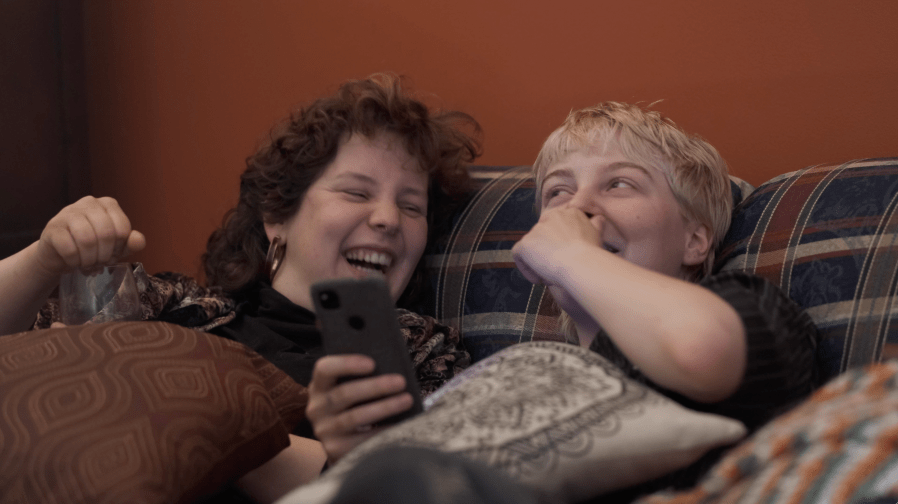
Fleurs Secheés, also known by its English title as Potpourri, is a portrait of three queer people, Arianne, Amé, and Marie-Michèle as they weather together the last months together as roommates in Montreal. The film intimately and intently follows their conversations, their relationship with one another, and their ultimate goodbye on the dreaded moving day. Fleurs Secheés is a deep exploration of youth, kinship and tenderness. The documentary, structured with a slice-of-life aesthetic, is a celebration that frames the joy of memories and the melancholy of goodbyes equally without undermining the importance of one or the other.

Juan: How was the film born?
Marie-Michèle: Fleur Sechees was supposed to be originally a portrait movie of different friendships. That was the origin story. I planned different couples of friends to do the portraits of but this was during COVID, so my roommates were the easiest and most accessible. As I was doing further brainstorming and writing, I realized this was enough for the film. At the same time, we had just decided that we were separating. We were all moving at the end of the lease. I knew I had a deadline, which was Moving Day (July 1st) and our conversation happened around April, so it was a now-or-never situation. This was what really pushed me. I was anxious to make my first movie because I had never directed before. The fear of losing that memory pushed me to at least film.
J: How long did you live with them? How did you establish your relationship with them?
M: I didn’t live with them for that long, only half a year, but I developed a close relationship with them. So, at the beginning of 2020, I was alone in Belgium post-break-up, and it was then and there that I began exploring my own sexuality because I was out there as a bisexual and I was surrounded for the first time by queer people. It was so cool to be out, and have conversations and meet new people. Then COVID happened and I had to come back to Montreal, to my parents’ home, where I was not out and I couldn’t see anyone. I knew I wanted to move out, I missed the feeling of independence. So when I moved in with my roommates, it was like a perfect storm. We were stuck with each other but at the same time, it was such a good setting to be at. And it was thanks to the pandemic that I was able to see them, we spent so much time together and that’s how it happened.
J: Was the film developed during pre-production or was it a consequence of the montage?
M: I had a basic structure when I came up with the movie. First, I talked with them, especially with Amé. Amé is a documentary icon! I planned with both of them that I was going to do one interview night and then I was going to record around them and the things they did. I knew I was going to do parallels, like the house full v the house empty near the end. However, even after planning, I knew I over-shot. The night of the interview, Arianne, who was studying to be a chef at the time, prepared us a salmon tartar, so I shot all the process, I shot us eating it and then I shot when we moved into the couch and talked. That was probably eight hours in total. I ended up removing much of what I thought was going to be the structure, which was the process and the cooking. I ended up introducing each of them and then introducing us together, so it kind of made sense. Overall, I think it is a mix of both, I did have an idea but then I had to edit for a while for it to come together. We shot in 2021, from April to July, and the movie was finished in 2023. Because it was my project I felt very self-conscious about my process and my camerawork. So many times I talked over them, I was like “Shut up, don’t talk!” But it was really fun to edit. I had several people watch it before. I think I ended up doing three cuts of the film, but after so many notes and time off, I just had to stop. I could’ve edited forever.
J: How did you balance intimacy and fly-on-the-wall camera work?
M: It was hard. I feel I interacted more than I thought and wanted, but in the end, I found it much more helpful. Removing the pressure of being a fly on the wall was the best choice, of course, my roommates are going to react to me entering their rooms with a camera. There was always a moment when they reacted and I had to intervene and say: “ok you do your thing.” It also helped me, mainly in the beginning. I was embarrassed, I didn’t know where to start, but it started to become natural. I also believe it was much easier to have two people instead of one, they talked to each other most of the time so I just had to comment and move them along with my notes. But most of it is just them being goofy, as they are! Ultimately that was my goal, for me to remember how great this was. The main thing I kept repeating to myself was that this project was for me, that was the only way I was going to finish it. This helped me puncture through the manufactured moments when they felt they had to be a certain way or answer a certain way, so going through that and getting into the actual essence of them was what I wanted the most. The fact that we could go from being very serious to a joke and back to a serious topic. When I watch it now, it feels as when I was there.
J: Why Fleurs Secheés?… why is it translated to Potpourri?
M: Fleaur Sechees came to be very early on. That’s something I find so interesting, particularly about documentaries, is that from the get-go I was drawn into shooting Amé and their flower bouquets. Amé had so many of them, and they even gave one to Arianne and me. So it just ended up being always present. When I ended up shooting her packing them up and writing Fleurs Secheés on the box that was when I knew. I wanted to end the movie there, it happened organically. I always kept around the bouquet she gave to me, which ended up being the final shot of the movie: Me crying in the car, with my mom, with the dry flowers. But that is also how I feel about the whole moment, you know, it is a nice bouquet and you want to preserve it, so you dry them and they become super fragile. It is like wanting to hold on to something and keep it beautiful. It became a symbol of the documentary. Knowing that each one of us had a bouquet in our house while editing was comforting.
For Potpourri, I had to come up with an English title for festival submissions and I was trying to find something that really fit, but Dry Flowers was just not hitting me. Potpourri just felt right, but it is funny because it is also a French word, we just use it as is in English. I also feel potpourri is also trying to make something beautiful out of dead flowers, so it works well too. I think a lot of people reacted positively to it, including my mom, they related to the importance of potpourri in their homes. I thought it was the closest relationship between titles to convey the flower theme, but it ended up being more than that!
J: Have Arianne and Amé seen the film? Did you screen it for them beforehand?
M: Yes, they have. I showed them a pretty final cut of the film in my apartment. I wanted to know if they were comfortable with the film or if they wanted anything cut from the final cut. It was a bit funny because we hadn’t seen each other for a while, but because I had been seeing them over and over again editing the movie, it was like they never left… Luckily, they were comfortable with the cut I showed them and we didn’t have to change anything in the editing room. It was really important to me to check with them because they were being very vulnerable so I was happy with their reaction to the movie. They even commented on how funny they were! Arianne kept saying: “I’m a movie star.” In terms of the creative process, Amé did shoot some stuff for the film but we didn´t end up using it, but both of them were helpful through the shooting.
J: Was it hard to maintain your distance as a friend? and as a filmmaker?
M: Not at all. Amé is a filmmaker and Arianne went to film school with us, so it was easy because we had shot stuff together before. I was even worried they were going to know too much, but on the contrary, it was all very smooth and easy. They were trusting and easygoing.
J: How does it feel looking at the movie now, after so many years of work?
M: It feels weird. I see it the movie and I see us. I see me. It is always weird to show something so close to you and personal. I am glad the movie came out. I still feel proud about it. It is like a time capsule of sorts, I wouldn’t change a thing. We only showed it at one festival, Inside Out [Queer Film Festival in Toronto] and it was a perfect experience. I love documentaries, so my goal was to make one that felt happy. I feel most documentaries we see tend to be sad, and although I can’t outrun the sadness that comes from leaving people I cared for. Yet, I wanted to make people laugh and have a good time. The dream case scenario would be to have people relate to my experience, and that happened during the festival. An older person approached me and said that the film reminded them of the excitement of meeting like-minded queer people. It was a dream come true! I felt my goal was achieved. I was able to convey joy and stay away from the dreadful feeling of emptiness some documentaries have. Also, seeing Fleur Sechees reminds me of the importance of what happened during the time I shared with my roommates. We had so many conversations revolving around coming to terms with our sexuality and identity. They brought me so much joy and happiness, even through really tough times. That’s why I think it is so important to show the film in front of its intended audience, including my parents, which I had just come out to the week before the festival. Even if it wasn’t shown I’m still very happy I put the movie out there and it gives me confidence to go and make another one.
 Short Ends