

During the latest edition of the Festival du Nouveau Cinema, I had the chance to watch Perdidos de Noche (2023) the newest film by Mexican filmmaker Amat Escalante. The movie follows Emiliano (Juan Daniel García Treviño) as he tries to uncover the disappearance of his mother in a rural town in the Mexican desert. The deeper he digs, he encounters several characters whose intentions are as dark as the plot that begins to unravel. With stellar performances from Treviño and his supporting cast (made up of professional and non-professional actors), Escalante is able to create a highly stylized layered noir that deals with the growing pains of Mexican youth in an unabashed portrait of guilt, justice, and redemption.
Thanks to its evocative themes and keen understanding of the social dynamics that permeate life and art, Amat Escalante’s fifth feature-length is a mix of his past interests and a new fascination with how fame, stardom, and art contrast with Mexican society.
Juan: I wanted to start by asking you about the actors, how was the process with them?
Amat: It’s almost the same to work with professional actors or not. Everything is very similar to me. I have a personal approach for each human; each person is very different with different stories. The closer you get, the faster you build more trust with the person, and work is ultimately better, whether they are professionals or not.
After directing some episodes of Narcos Mexico (2018-2021) I wanted to apply the techniques that I learned working for TV in a film that was mine. So there’s also that aspect of trying new things that I have always had. Since Region Salvaje (2016) which was my previous film, I have worked with people who have helped me off the set and on non-shooting days to prepare the actors.
In Perdidos de Noche, we were able to work with both types of actors and we had a team whose specialty was non-actors. They helped me with preparation and concentration exercises. On set, it’s a lot about being in the moment and the practical aspect of what works. It’s important to provide a safe space, a space of comfort, trust, and belief in what we are doing. Even if it’s not always clear, it doesn’t matter when there is trust and the pursuit of a feeling.

J: What were your visual and narrative references?
A: I work a lot with people close to me. In this case, I wrote the script with my brother Martin, with whom I wrote my second film, Los Bastardos (2008). We already know what we like and what attracts us. Perdidos de Noche was written mostly when the pandemic began, so there was more time in general to develop it. It gave me time to do things I hadn’t done in many years due to a lack of concentration, like focusing on literature, especially Dostoevsky, and I feel that affected the film. I feel like I discovered that many of the influences that had affected my filmmaking had come from the Russian writer, and surely before him, there was someone who inspired him. Discovering that the type of cinema that has affected me the most is so tied to Dostoevsky’s literature was very important to me, and that gave me a certain confidence to be inspired, read, and be excited.
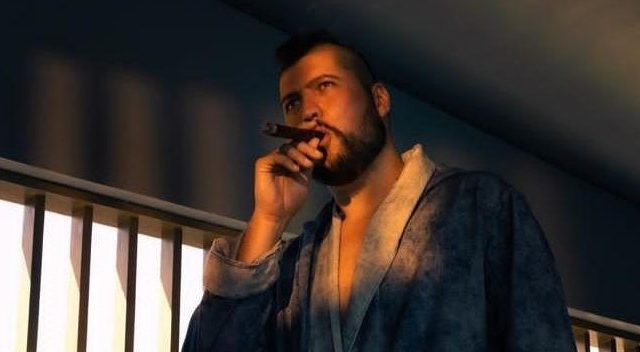
There was also a lot of film noir that I saw. Specifically, a film that was very important for me but that goes almost undetected in my film was Hitchcock’s Vertigo (1958). There was something about the confusion and innocence, guilt, double personalities, and people’s true motives. Another film that impacted me was Elia Kazan’s Wild River (1960), the town where I wanted to film had the same story as the town in Kazan’s film; they flooded it to create a dam. That movie was also a great reference in terms of format and visual language. For me, it has always been my attraction to tell about the things that are wrong in my country, the contrast, the drama, social inequality, and violence, without the need for guns or physical violence… sometimes just filming is violent in and of itself. Perdidos de Noche also made me question how I relate to the history of my country as an artist, and how others have depicted it too. I’m not saying it’s wrong to be inspired by what is happening because it has been like that from the beginning, with painting, literature, and music; we all have to talk about something. But making art from tragedy… I find it interesting to explore that. That’s why I put in the film the character of Rigoberto (Fernando Bonilla), someone who exploits and uses tragedy for his art and benefit.
J: How do you balance fabricated realities and lived realities?
A: In general, in my films, the idea is not to give a moral lesson; I prefer not to do it and let it come naturally. What you mention in your question is part of the contradiction of doing cinema in a country like Mexico. The concept of “reality” in cinema is so apparent and strong, and much is done that way. Everything exported abroad arises from that contradiction of exposing, of pointing the finger at wounds, but there is also something strange about using these wounds. In Colombia, it has also been talked about; filmmakers like Luis Ospina have made it known in movies like The Vampires of Poverty (1977). The people who live the stories that filmmakers tell often do not have time to tell about them themselves; that is the nature of the situation. A lot like Dostoevsky, but it’s not a competition of suffering.
J: What is the relationship between guilt, justice, and redemption, for you, as well as for Emiliano?
A: I think it’s very overwhelming to find a solution or an answer; it’s almost impossible. I believe you have to find another way. In Mexico (and other countries), you have to look for something that fills the void justice leaves; it’s part of our human nature. When justice does not exist, everything begins to collapse. I was interested in seeing the intimate and personal consequences of Emiliano while reflecting on the bigger issues. That was my bet with this and my other films, getting into personal details and seeing the consequences of a national or universal system of something that does not work. I am inspired a lot by the physical place, that’s why I always shoot where I live, with the people I know, on the paths I walk on. For example, the house in the film is a space that already exists, which in itself already generates a dramatic contrast.
J: How does the ambition of art compare to the reality of history?
A: It could be understood as a light in the darkness. Let’s say you’re in a dark hole and you have a lamp, you can’t see everything, but you can see parts and understand what you see. That is the approach from an artistic and creative perspective. It’s not a solution, and I’m not looking for solutions; it’s an expression of something that is in that imaginary cave (like Plato’s myth). And there is also a frustration that comes with it, which is a natural part of art; it’s not a complete revelation, they are flashes of light.
 Short Ends