

Director and writer Ana Lily Amirpour knew exactly what she was doing when she titled her 2014 “Iranian vampire Western horror film”, allegedly the first of its kind, A Girl Walks Home Alone at Night. After all, walking home alone at night is something that girls are usually pretty actively discouraged from doing. One might think at first glance, then, that the titular girl in question will end up finding herself in grave peril, but it’s actually quite the opposite: she’s the vampire, and the most dangerous character in the film. Fearing for one’s safety while alone in public, especially after dark, certainly isn’t exclusive to any gender, but I’ve often felt as a woman that girls and women in particular are expected to be constantly hyper-vigilant against any and all possible dangers that may be lurking in the shadows. In contrast, our vampiric anti-hero (Sheila Vand, credited simply as “The Girl”) is the one to watch out for rather than the one who needs to be vigilant, and the result is somewhat of a supernatural power fantasy that subverts expectations of what it means to be truly vulnerable.
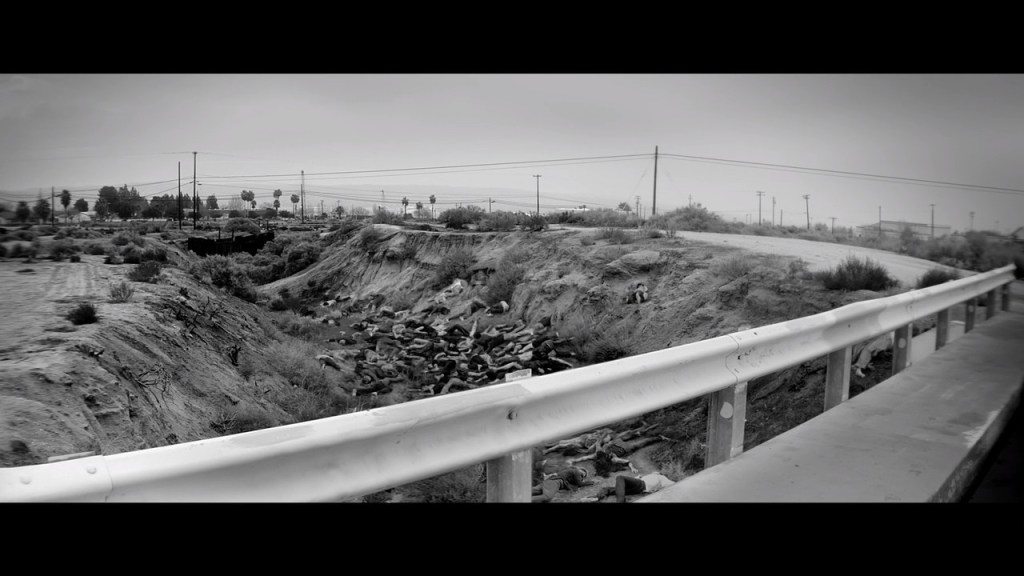
Evoking classic horror and film noir, A Girl Walks Home Alone at Night was shot in black and white, blurring the line between harsh reality and dreamlike phantasms in the fictional contemporary setting of Bad City, Iran. It’s a seedy desert locale that feels as macabre as it does anachronistic, which is exemplified in the film’s opening sequence where we see the character Arash (Arash Marandi) carrying his cat nonchalantly past a pit filled with dead bodies before driving off in his 1957 Ford Thunderbird. These genre-blending worldbuilding elements create a sense of distorted reality and even have their roots in the gothic horror genre, which has evolved from “mostly European ghost stories that took place in decrepit mansions and crumbling castles into something a bit more atmospheric and melancholy,” (Media is Mythic).
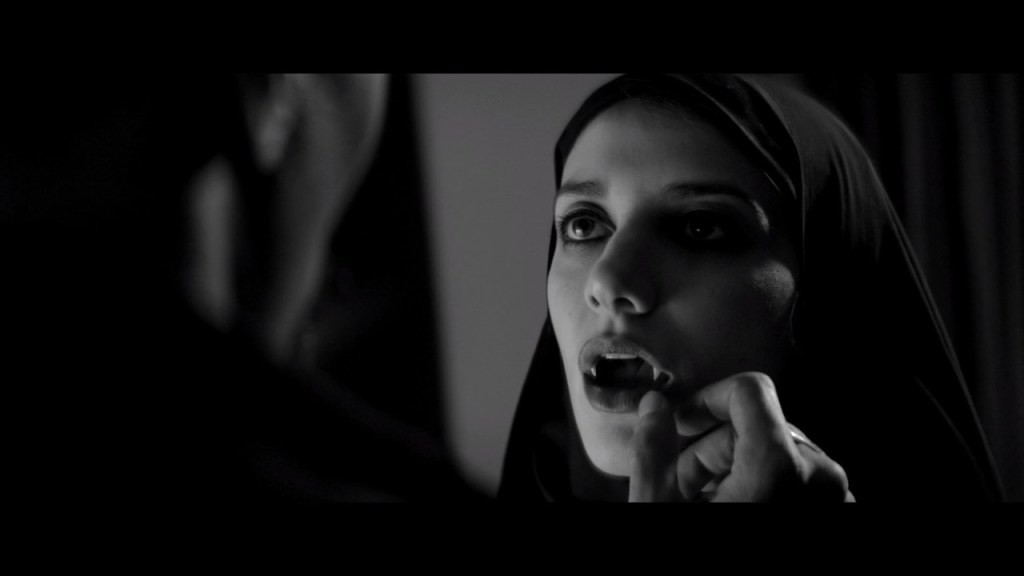
The existence of vampires feels so natural to the world of A Girl Walks Home Alone at Night that the word ‘vampire’ doesn’t need to be spoken aloud even once during the film, with The Girl’s characterization retaining many recognizable elements of the archetypal vampire, even while taking inspiration from various sources. The decision to have The Girl prowl the streets of Bad City in a black chador was inspired by an event from Amirpour’s own Iranian-American upbringing, specifically a memory of wearing a relative’s chador while riding her skateboard. The garment is usually meant to fit the wearer modestly, but The Girl wears hers open like a cape, making her look all the more vampy as she lets it billow out around her. Other influences include Anne Rice’s Interview With the Vampire, F.W. Murnau’s 1922 silent horror film Nosferatu (which was an unofficial adaptation of Bram Stoker’s Dracula), and Kathryn Bigelow’s 1987 cult hit Near Dark (StudiocanalUK). The aesthetics are so universal that this is perhaps why when The Girl bares her fangs to her first victim in the movie, a pimp and drug dealer named Saeed (Dominic Rains), he doesn’t seem all that surprised. He recoils slightly, but then laughs and knowingly says, “Ah.” Then the Girl bites his finger off and drinks his blood.
Even Bad City’s human inhabitants have vampiric tendencies. According to Amirpour, “A vampire is so many things: serial killer, a romantic, a historian, a drug addict (…),” (Watercutter), and the central characters of A Girl Walks Home Alone at Night each reflect at least one of these facets as they fight to sustain themselves on the fringes of society and often at the expense of others. Arash works hard to provide for himself and his drug addict father, Hossein (Marshall Manesh), but has to resort to petty theft and selling drugs for Saeed. Hossein’s addiction might be likened to a vampire’s bloodlust, and it’s a considerable drain on his son. Saeed perpetuates a cyclical suffering in the community, exploiting people’s dependence on him for drugs and sex work. Atti (Mozhan Marnò) is a prostitute who works for Saeed, another type of woman who walks alone in the night, and although her profession could represent the stereotype of vampires seducing their victims and using their sexuality for their own personal gain, she’s merely trying to make her way in the world like everyone else. Bad City itself is even “a vampire of sorts”, its oil drills “draining the earth (…) and slowly killing it” (Media is Mythic). There’s an interesting side character named Rockabilly (Reza Sixo Safai), who has no lines and wears drag makeup and a headscarf, not really doing much else besides chilling in the background and, in one scene, dancing in broad daylight with a balloon. Ampirpour has described Rockabilly as being gay, stating that the character’s inclusion in the film is “the one political thing” (as opposed to the chador) because “it’s not OK to be gay in Iran” (Watercutter). Given today’s rather hostile political climate against drag and queer expression all over the world, it adds another layer to the film’s subversion that a character who might otherwise be vulnerable in public is allowed to simply just exist.
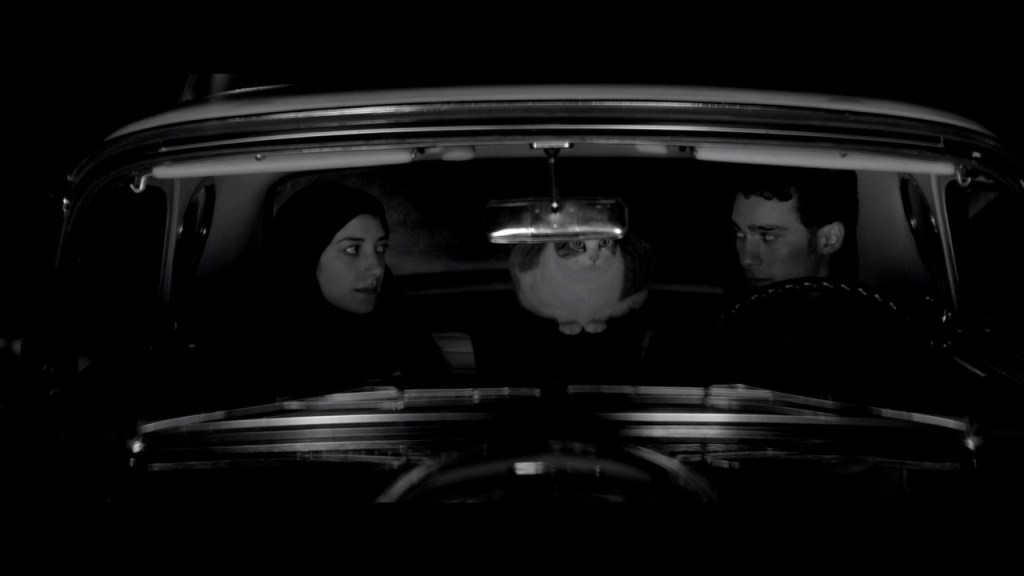
Vampirism aside, The Girl also exhibits behaviors that are very down-to-earth and human, with her most human trait being that of loneliness. She’s initially a very solitary figure who keeps her distance from humans unless she’s looking for a midnight snack. She also appears to be quite morally gray; she goes after bad men like Saeed, but she’s also shown drinking blood from a homeless man and frightening a little boy into giving her his skateboard. Although this is a film that speaks for itself quite well and doesn’t require any unnecessary exposition, a prequel comic reveals a fascinating backstory for The Girl wherein she goes into a self-imposed exile in the desert after witnessing the brutality of the Islamic Revolution, resurfacing in Bad City decades later (StudiocanalUK). Even without this knowledge, it’s obvious that when The Girl begins to cross paths with Arash, it’s her first human connection in a long time. During their first encounter, The Girl is leaving Saeed’s apartment fresh from the kill, and it’s unclear whether the blood is visible enough on her face for Arash to put two and two together. The second time they meet, Arash is attempting to walk home while coming down from a trippy ecstasy-fueled rave sequence. He’s dressed as the cartoony version of Count Dracula that most people probably envision when they hear the name, complete with a cape and plastic fangs, and while The Girl is wary of him at first, she takes pity on him and pushes him back to her place on her stolen skateboard.

This brings me to my favorite scene in the entire film: Arash is laying on The Girl’s bed in her room, with band posters covering the walls and a disco ball hanging overhead. The Girl puts on a vinyl of White Lies’ “Death”, and the song plays nearly in its entirety with no dialogue as Arash gets up and moves closer to her. The Girl slowly tilts Arash’s head back and exposes his neck almost as if she’s going to bite him, but instead she lays her head on his chest and listens to the sound of his pounding heart. It’s such a tender moment, and it also highlights how The Girl’s most human moments are often tied to music. We see her in this room in an earlier scene where she dances alone to the song “Dancing Girls” by Farah right before she goes to kill Saeed (I actually originally wanted to write about A Girl Walks Home Alone at Night for June’s music edition before work and school got in the way; the film’s genre-blending is very obvious in its soundtrack, which has an incredible mix of Iranian and Western music ranging from indie rock to house to sweeping spaghetti Western-style instrumentals). Sparse dialogue can be attributed to Amirpour having written the script in English while keeping in mind that the actors would be delivering their lines in Farsi (Vice), but the absence of speaking lets these beautifully hypnotic musical moments shine. Even the sound effects are great—you know that in a movie called A Girl Walks Home Alone at Night, those footstep Foley sound effects are gonna be fucking crisp.
The Girl’s intimate moment with Arash only seems to heighten her hesitance about letting him get close to her. On their second official “date” at a nuclear power plant, The Girl tries to spurn Arash’s advances by insisting that she’s a bad person who’s done bad things. Her other tenuous alliance is with Atti, to whom she gifts Saeed’s jewelry and other valuables stolen from his apartment. The relationship is almost like that of an older and a younger sister, with the irony being that the immortal Girl has been around much longer than Atti, and The Girl eventually comes to Atti’s aid after Hossein forcibly injects her with heroin during their dalliance. Hossein’s death is actually quite heartbreaking, especially considering that it’s his struggles with addiction that finally force Arash to put him out on the street and lead him to his demise. He, too, was clearly a very lonely person who was haunted by his past—at one point he thinks that Arash’s cat is possessed by the spirit of his deceased wife (he’s made to sound delusional here, but I think that in a world where vampires exist, people’s dead wives can definitely be cats). With this new complication arising between The Girl and Arash, there still seems to be no turning back now that The Girl has rejoined the land of the living.
Thinking back on my earlier statements about the general atmosphere of anxiety surrounding being vulnerable in public spaces, I’m reminded of growing up in a culture of rugged individualism in the United States that’s far more isolating than it is empowering. Those with truly monstrous intentions know how to fly under the radar in a society of highly reactionary and paranoid people who are deeply suspicious of one another, which isolates us even further and causes us to create monsters out of those who are perceived as the “other”. I think that A Girl Walks Home Alone teaches us how to find strength in being vulnerable and finding community, even if it starts with just one person. I also think that there’s a lesson in embracing the scary and monstrous sides of ourselves. I’ve personally always been more partial to werewolves and mermaids than vampires—maybe it’s because of my fascination with transformation, unbridled animalistic desires, and the state of existing between two worlds, but even I can admit that there’s something endlessly alluring about vampires.
Works Cited
“A Girl Walks Home Alone at Night and the Melancholic Beauty of Gothic Horror.” YouTube, uploaded by Media is Mythic, 21 Dec 2020, https://www.youtube.com/watch?v=GUdJ3yDXHuA&list=LL&index=4&t=95s.
“A GIRL WALKS HOME ALONE AT NIGHT – Director Ana-Lily Amirpour Interview.” YouTube, uploaded by StudiocanalUK, 30 Aug 2022. https://www.youtube.com/watch?v=js2R8b6_giY
“Talking to the Star and Director of ‘A Girl Walks Home Alone at Night’ – VICE Meets.” YouTube, uploaded by Vice, 11 Dec 2014, https://www.youtube.com/watch?v=4wlm97DiUq8.
Watercutter, Angela. “Meet the Woman Who Directed the World’s Only Iranian Vampire Western.” Wired, 5 Feb 2014, https://www.wired.com/2014/02/girl-walks-home-alone-at-night/.
 Short Ends