

This year, in the unfortunate circumstances of ongoing war the world has gained access to the Ukrainian documentary cinema, and one will probably see fiction cinema about the Russian invasion coming out in the nearby future. In this review, I will address Ukrainian documentaries that have premiered at the 2023 HotDocs Festival in the category of ‘Films that Bring the Victory Closer’, as well as several others that deal directly with the topic of war and Russian occupation. This review aims to provide an overview of the phenomena by dividing the films into three categories: those that deal directly with the subject of warfare and military, those that engage with the concept of community, and those which tackle the stories of refugees. One pattern that can be seen in all the films, however, is the omission of capital ‘R’ in the subtitles, whenever the word ‘Russian’ or ‘Russia’ are used. This is the ‘trend’ that has originated in the Ukrainian and Russian-speaking online space and is intended to signify contempt towards the country and its actions, through foregoing a grammatical rule.

Two films that engage directly with violence and loss, 20 Days in Mariupol by Mstyslav Chernov and When Spring Came to Bucha by Mila Teshaieva and Marcus Lenz are situated in two different time periods, while the former captures the first days of the active invasion, the latter deals with the consequences of occupation after the town has been freed from the Russian troops. Brutal in its explicit portrayal of death and suffering, 20 Days in Mariupol is told from the perspective of Associated Press journalist Mstyslav Chernov, who has been involved in covering the political life of Ukraine, the Revolution of Dignity, and the war in Donbas in the past. Chernov brings his perspective not only through the voice-over and first-hand view camera operation but primarily through the montage sequences that interconnect his family and the turbulent events of the recent years, that have resulted in the ongoing war. 20 Days in Mariupol symbolically reanimates and contextualizes many photographs and short videos that were available on mass media outlets both locally and internationally. With the crew taking base in the local hospital, the film primarily focuses on the abject reality of war, murdered children, people missing limbs, and relatives screaming for their loved ones who could not be saved. The film brings the viewer into the pit of confusion and terror, where looking at the screen sometimes is impossible, due to the hopelessness and pain that the camera captures. When discussing the genre of documentary, it is often important to consider the notion of exploitation, specifically when dealing with an explicit demonstration of violence and suffering. And while one can argue that the portrayal in the 20 Days in Mariupol is exploitative of people’s lives, I would have to disagree, as the context of the war in Ukraine is quite different and is riddled with layers of propaganda coming from the Russian side. At one point in the film, a doctor from the hospital notices the crew filming the surgery he is performing, he then proceeds to scream at them to encourage the operator to film every detail for Putin and the population of Russia to see. The goal here, then is not to produce excitement from the audiences via a voyeuristic pleasure of looking into the violence, but to document the evidence and demonstrate the true face of war for both local and international communities. The films act as witnesses and evidence, condemning the criminal actions of Russia, the government of which proceeds to deny it until this very day.

When Spring Came to Bucha by Mila Teshaieva and Marcus Lenz continues this pattern, this time demonstrating the conditions of life post-occupation in the small town of Bucha, close to Kyiv. The scenes of exhumation of bodies from mass graves, and subsequent re-burial, are mixed with the bureaucratic hell that the residents have to deal with to find and identify their relatives and loved ones. The remaining mines and destruction of the property that Russian soldiers have left behind are almost symbolic of the lingering trauma that both residents and the town experienced during the time of occupation. The topic of propaganda comes up yet again when one of the interviewees discusses the relationship with her relatives in Russia, who despite her testimony refuse to believe that the war is happening. The film provides its testimony of trauma, death, and destruction that Russian troops have caused, not as explicitly as 20 Days in Mariupol but rather through the contrast between blooming spring weather, and the violated land, covered in tank tracks, bullet shells, and bodies. While nature might be beginning the new cycle, unfortunately, the people of Bucha would not be granted the same luxury of forgetting and starting over, as the city will always bear the memory of violence and death that has occurred there. Both films, however, are not completely pessimistic, as even though they focus on suffering it is not pity that they invoke, but rather resentment towards the enemy and notion of pride, which could be further seen in the films that deal directly with community and refugees.
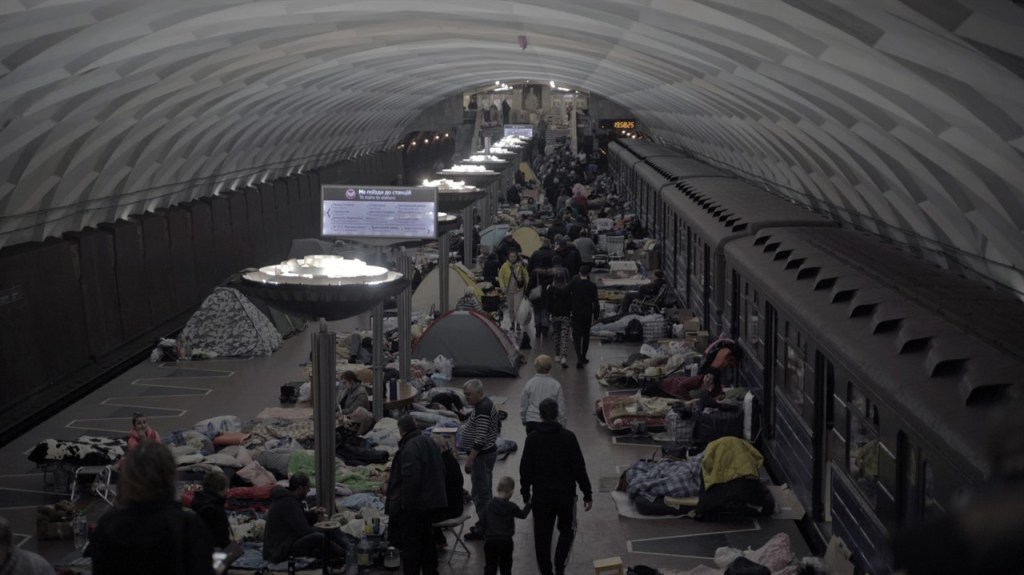
The notion of community, and specifically of the newfound family is a recurring topic in the documentaries that deal with civilians in the territories, which do not have active warfare, yet still are affected by the very context of the country at war and the constant threat of missile attacks. 89 Days by Pavlo Dorohoi for instance focuses on the people who had taken refuge in the Kharkiv metro, their make-shift camps on the platform and trains, as well as their relationship with each other. People bringing their plants, belongings, and animals transform the space of mundane passing into a new home, where strangers are now bonded over tragic circumstances. Specifically, one family and their escapee cat become the focus of the film, as the child shows and explains the drawing of their family’s temporary setup to the operator. The only connection to the outside in this category of films is the mobile screens that project horrific imagery of war into the safe and homey commune underground. The people here are not represented in the distanced attitude of pity, but on the contrary, the film passes a critique onto the government in handling the situation, accommodating the citizens, and later evicting them. The notion of pride here is quite important in understanding the position of the civilians and filmmakers, as despite horrific circumstances one still aspires to maintain their appearance and way of life like women getting their nails done on the station in an attempt to maintain their mundane habits.

Our Robo Family by Anastasiia Tykha has the same attitude of demonstrating the continuation of ordinary life in traumatic circumstances, following the story of the robotics club that had to relocate first because of the war in Donbass, and now because of the Russian occupation. The film demonstrates endurance over the circumstances by continuing the existence of the club, despite the relocation and lack of resources. Maintaining the normal is perhaps one of the ways to cope and deal with the traumatic experience of the war, and the film focuses exclusively on this. And while the boys do not get to win their medal for the first competition they go to, they eventually succeed, as it is mentioned in the credits, symbolically alluding to the potential victory in the future.

Guests From Kharkiv by Halyna Lavrynets, perhaps the most positive one of all films, focuses on the story of a group of people from Kharkiv who escaped the city to find refuge in a small village. The film presents the adaptation of the urban dwellers into the pastoral setting and manual labour, which produces a well-known comedic effect. Once again, the war and violence are only seen through the screens of mobile devices, while the new residents remain in the safety of the village. The film presents the formation of a new family that finds connection through the experienced trauma. And while, as the credits state, most of the refugees have returned to the city to avoid one more year of manual labour, the film demonstrates the deep connection to the land not only on the symbolic, but physical register. One common aspect of the films I have discussed so far is the celebration of Orthodox Easter. This holiday is perhaps the most significant event of the year for Orthodox Christians, and most of the documentaries in one way or another demonstrate the gathering of community at the table, celebrating despite the horrific circumstances.
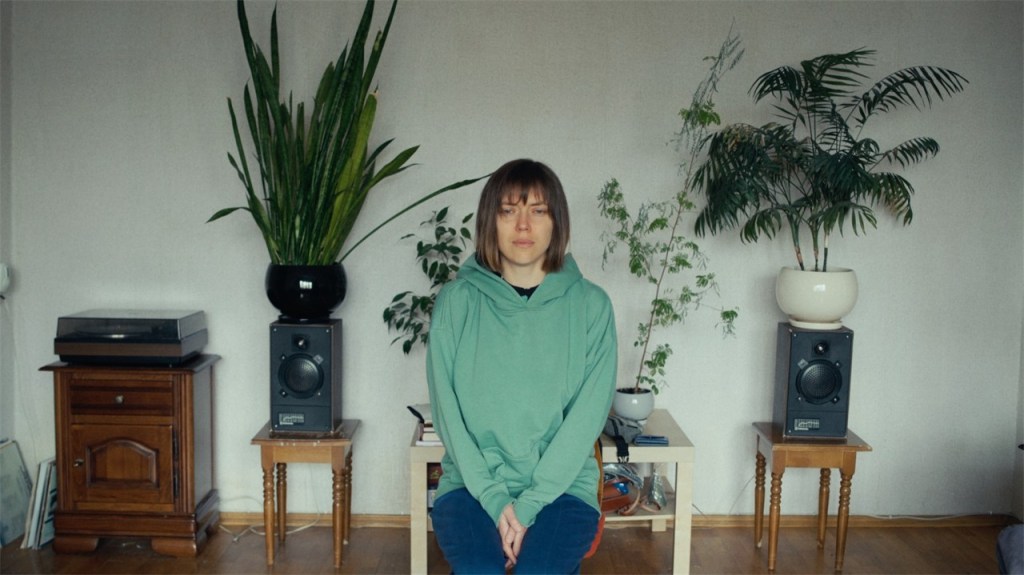
The last sub-section of the films that I want to address here is the stories of refugees who despite the ongoing war make their way back to the country, looking to be with their loved ones. I Did Not Want to Make a War Film by Nadia Parfan begins as a travel vlog, where the narrator explains how her yearly escape to the warmer side of the world, was interrupted by the beginning of the war. This very intimate and beautiful short film takes the viewer through the emotional and physical journey of returning home. Parfan reflects and reminisces on the peaceful past, and the fate of her relatives and friends who escaped or stayed in the country despite constant sirens and attacks. I Did Not Want to Make a War Film is about an individual’s perception of a new way of life, not politically but emotionally, demonstrating the mental turmoil one continues to go through daily. The very title of the film signifies the suddenness and confusion of the war, focusing on the person who is not in the war zone, yet experiences the trauma and despair of the situation, which is quite a unique perspective that rarely gets seen on the screen or talked about in the media. Under the Wing of a Night by Lesia Diak in a similar way explores the story of a mother and daughter who had to temporarily leave the country, while the father stayed in Ukraine. The film focuses on the feelings of isolation and loss, specifically loneliness associated with being in a foreign country and only seeing your loved ones through the mobile screen. Belgium becomes a state of temporality and unknown future, where the mother and daughter are not exactly refugees or visitors, but displaced people existing in the liminal space. The end of the film shows the long-awaited reunion of the family at the train station, a heartwarming moment, that contrasted with the sad mood of the film, creates a hopeful feeling. Both of these films are unique in their interpretation of refugee stories, as they are much more focused on the emotional and personal experience, rather than conditions or political implications.

It has been a little more than a year since the war started in Ukraine, and while Russia still maintains the narrative of liberating the country from its imaginary enemies, the whole world has become aware of the crimes committed during the time of occupation. The films discussed here are just another recorded testimony of Russia’s aggression and endurance of the Ukrainian citizens, which is now available not only as shocking newsreels but as personified and contextualized stories of people, who have experienced loss, separation, and displacement.
 Short Ends
1 Comment
Comments are closed.