
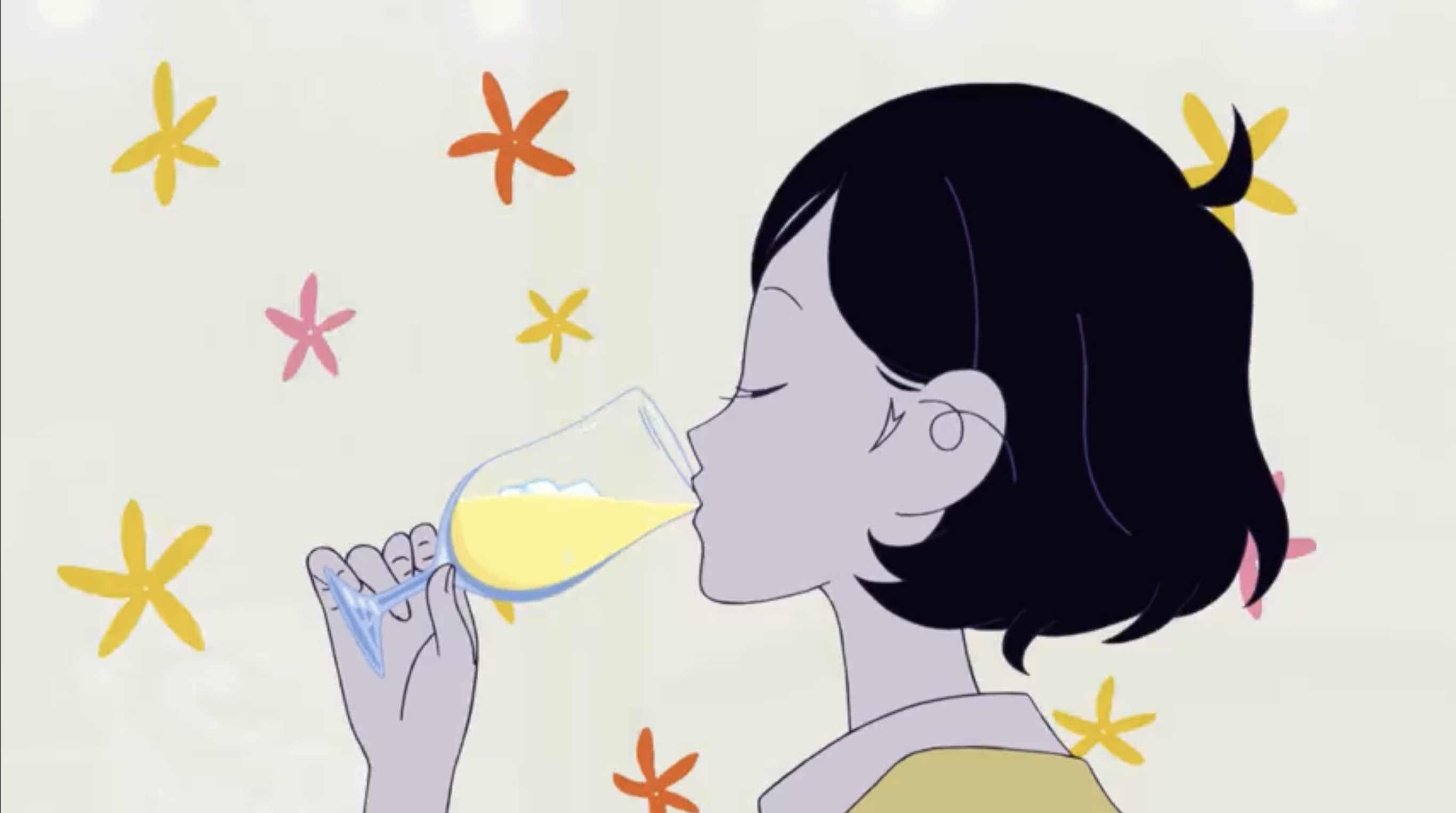
What Night is Short, Walk on Girl (Dir. Masaaki Yuasa, 2017) brings to the table is the contrast between two philosophies that exist within us all. It is a film about juxtapositions; the desire to live according to a script, and the desire to march forward and experience things as they come. Night is Short is a romance between these two ways of living and it tells this story through the lens of college nightlife. What makes this film unique is its elevation of a night out into a whimsical adventure. The film achieves this through one of its strongest elements: sound.
As a university student finishing up my first year, I find myself reflecting on the depictions of college life in cinema. While my experience is not reflected in this film whatsoever, I can’t seem to get this film out of my head, like a catchy song. My relationship with Night is Short is a pretty new one. I first watched it in March of this year as I was casually looking for the wacky hijinks one might find from a Masaaki Yuasa film. What I wasn’t expecting was for the film to quickly transport me to my childhood within three minutes of the runtime. The unnamed female protagonist who I will be referring to as Otome, narrates her intentions for the night and marches forward into her adventure. The music that accompanies her is a chipper and infectious theme. I found it to be instantly recognizable as an elicitation of nostalgia and the carefree nature of youth.
There is “music” everywhere in this film, even when there is none. Sound effects and editing give the film a distinctly melodic flow. For example, the rhythmically timed clinking of glass when Otome is drinking or the jingle that plays every time the god of the used-book market appears. The musicality of life itself is given the spotlight. This style blends the visuals with its sound well, making the two inseparable. Otome’s theme is one of the most memorable parts of the film in my experience. It follows Otome around, marking a new path to her journey. It is a signifier of the contrast or juxtapositions that the film emphasizes. Otome’s theme is overwhelmingly positive and is often accompanied by a train sound effect which represents her determination to move forward. The song elicits feelings of joy and curiosity, fitting for her positive disposition. She is rarely seen without this song following her and it sets her apart from the rest of the movie’s cast of characters. It parallels her appearance on screen, instantly grabbing the attention of the viewer, her presence becomes almost oppressive. Otome is a representation of the forward-facing drive that exists in everyone. The universal desire to explore, to learn, and to progress can be found with Otome. Her theme song is what signals her presence, it lets the viewer know that this character exists in all dimensions of the film. She is visual and aural, her existence transcends the confines of the diegesis that other characters exist in. When I first heard her theme, I was immediately transported back to my younger self. I felt that pure optimism that I used to have as a child reflected in her journey. Otome is nostalgia. She is the embodiment of what young people want out of life.
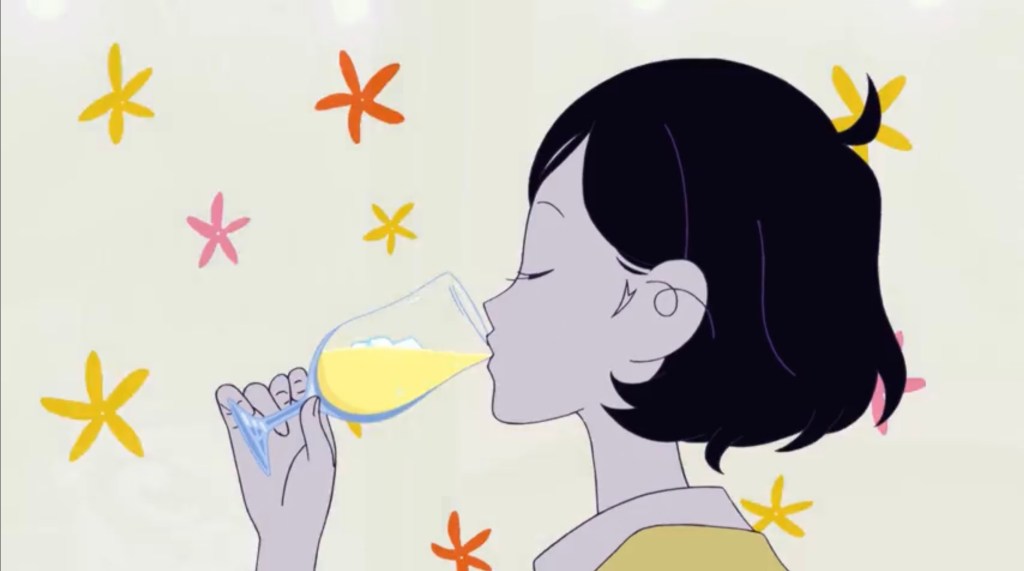
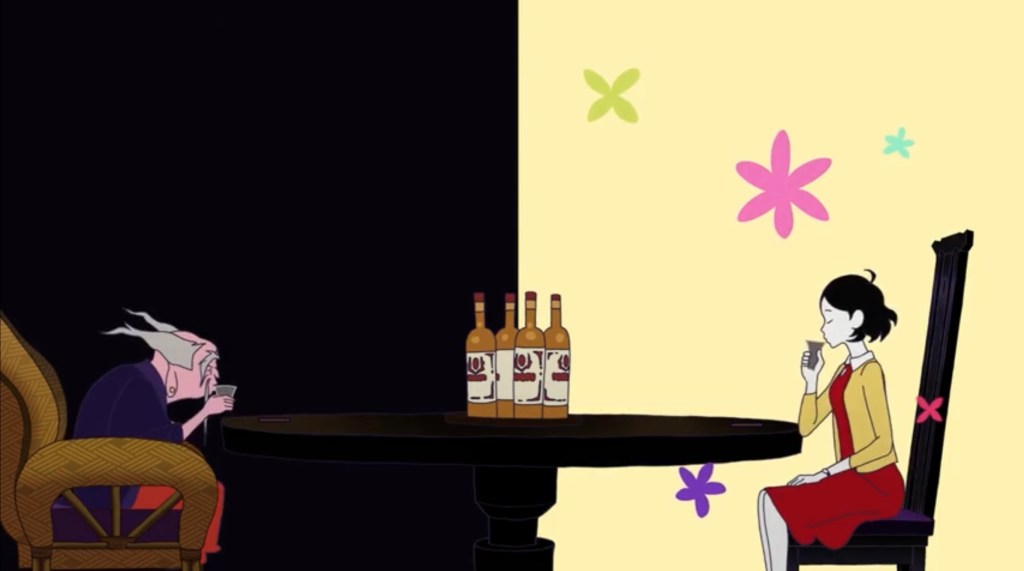
Her theme’s significance is made evident in the pub crawl sequence that takes place in the beginning of the film. Otome embarks on a journey to drink an obscene amount of alcohol with the people of Ponto Cho. Her ability to drink so much inspires her drinking friends to encourage her to challenge Rihaku, the old loan shark, to a drinking game. To contrast with Otome’s night, Senpai, who is having a very different night, is focused on getting Otome’s attention. His fixation on her results in him losing his pants and getting entangled in the drama of an old pervert who owes Rihaku merchandise. Senpai’s obsession with Otome causes him to get stuck on obstacles while Otome finds herself in an important contest against Rihaku. Senpai is stuck in other people’s drama, a lifestyle that he has found comfort in due to his fear of actually progressing any potential relationship with Otome. The sound during his scenes do not have the same magnetic energy as Otome’s. For example, the music is noticeably drab when he is stuck listening to the problems of Todo at the bar. Meanwhile, Otome is featured in a vibrantly presented pub crawl montage with exciting music, complemented by the drinking groups chanting for Rihaku’s presence. The drinking scene on Rihaku’s boat is pivotal to the themes of the film. Rihaku elects “Fake Denki Brandy” for the game, a beverage that was created in an effort to recreate “Denki Brandy”, a fact that Rihaku uses to justify his nihilistic outlook on life. He sees the drink’s failure to replicate as evidence of the hopelessness and loneliness of life. Otome has a complete opposite reaction to this drink. She believes that life is beautiful, warm, and unique just like the drink. As the two drink, they narrate their respective dispositions with Otome’s and Rihaku’s themes hard-cutting between them. As Rihaku loses his will to continue drinking, Otome’s theme continues to play during his turn. The film communicates Otome’s dominant positivity through the music. Her infectious optimism is manifested through the soundtrack and grows into a more universal signifier of joy as Otome’s friends celebrate her victory to the non-diegetic backdrop of a victorious tune. Her love for life is no longer just for her, it’s for everyone.
As Otome continues her night, she finds herself literally embodying the music of the film as she becomes the lead actress in the guerrilla theater production of “The Crackpot of Monte Cristo”. She is tasked with performing musical numbers that tell the story of a princess relentlessly looking for her true love. What I found interesting about this musical sequence was the fact that the music entering the diegesis marks the turning point for all characters. For the first time, Otome has found herself the lead actor of someone else’s story. Her theme song is no longer present, Otome has stopped her forward trajectory and has opened herself up to singing someone else’s music. Similarly, Senpai changes his respective path and intentionally interrupts the play without a preconceived plan. This play creates a space where all characters can see their own approaches to life and romance from another perspective, causinging a shift. The play brings nuance to its characters, suggesting that Otome’s relentless forward motion is not always necessary and that perhaps slowing down to see what’s in front of you is sometimes needed. The majority of the film has maintained a speedy rhythm, one that can be intoxicating, so it’s important that it acknowledges when it’s appropriate to take a breath.
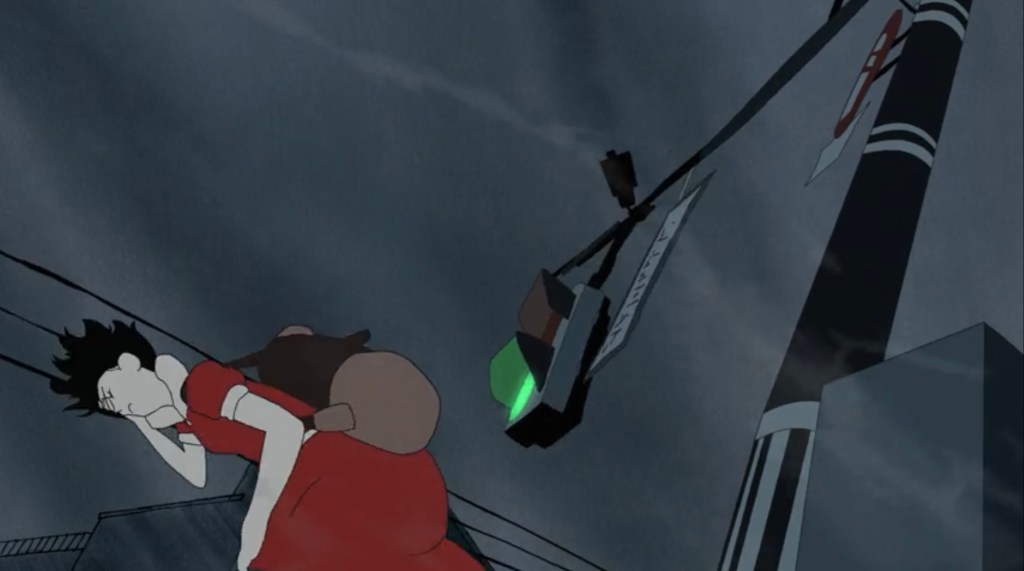
What I found so captivating by Night is Short is how simple its use of sound is. Yuasa wastes no time explaining certain nuances of the film through any complicated means. If Otome is happy, her theme plays, if she isn’t, then something else is audible. If Otome’s motivations need to be understood, she will orate said motivations out loud for the viewer. Night is Short has somewhat of a “tell, don’t show” approach in this respect. The pandemic sequence near the end of the film features very little soundtrack music, which is a tonal switch. The use of music (or lack thereof) in this sequence is meant to indicate the collective contemplation of all the characters we had spent the night with. Otome’s theme made such frequent appearances throughout the film that its absence is almost uncomfortable. Everyone is sick in bed, thanking Otome for the night she gave them as she visits them one by one. This moment of calm is removed when Otome comes to the conclusion that her fate lies in talking to Senpai. The aural space of the film is filled once more, but this time, not with music, but with the chaotic arguing between Senpai’s conscience, represented by a room full of politicians and cowboys. The film becomes quite surreal during its final act, with Otome fighting off Senpai’s internal creatures in order to climb a tower and reach him. The music in this scene implies action; it grounds the viewer into something a bit more familiar in order to guide them. There is no need to truly understand what is literally happening. What is important is what the music is telling you: this is the third act. Something big is about to happen. The film concludes with the two meeting and completing their respective character arcs. Senpai realizes he should be direct with Otome about his feelings, and Otome realizes that it’s ok to share her space with others.
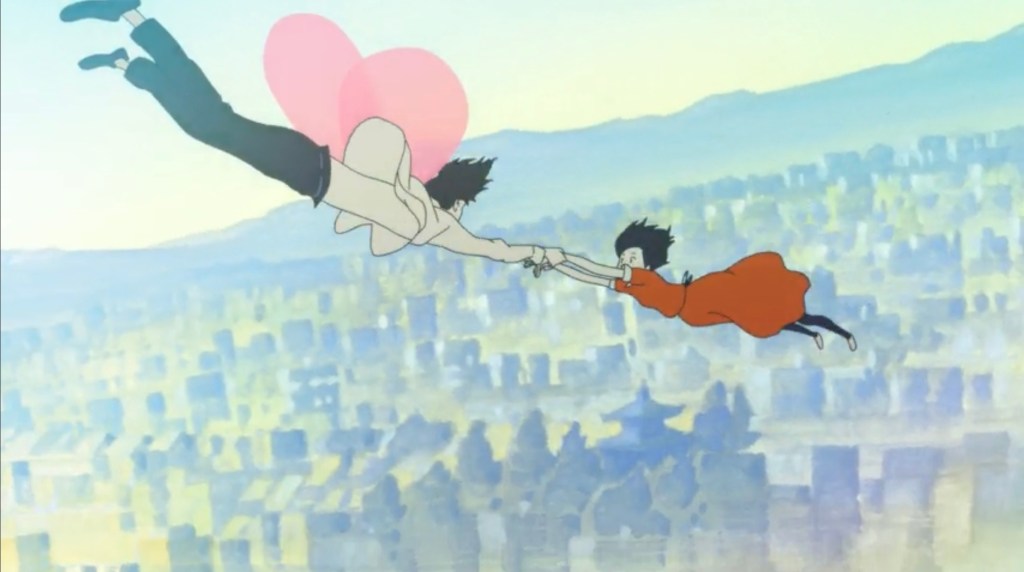
I started my first year at university with stars in my eyes. I was so excited to learn, meet new people, and create new things. My first year has concluded and looking back, there’s a part of me that’s disappointed in my experience. The exciting adult life as portrayed in so many movies was never present in my time. Instead I was met with a year of uneventfulness. What I found so spellbinding about Night is Short is its messaging, that the magic of the film is attainable, it’s all about what you do with your time. The film implores you to listen to the musicality of your life and make what you will of it. It is messaging that might sound cliche or overly simplistic but I would argue that Night is Short, Walk on Girl avoids any condescension. The film does not present romance or joy as an easy guarantee. It acts as a how-to guide for fulfillment in the life you have. Through its juxtapositions, it presents the fine balance between moving forward and staying still. My first viewing of this movie left me feeling seen. The world is a magical place filled with music and all you have to do is participate.
Works Cited
Night is Short, Walk on Girl. Directed by Masaaki Yuasa, produced by Science Saru. 2017.
 Short Ends