
We hear an average of 1.3 million songs in our lifetime. How many of those songs stay with you throughout our lives? How many of them can you sing by heart, without music? How many can you pinpoint fundamentally changed you, saved you, made you better, made you worse?
Music grips us. In our most vulnerable moments, it rings out like a beacon. It puts words, sounds, feelings, texture to our experiences and creates a space for us to dissolve into. In the span of a song, we can truly step away from ourselves. Our problems shrink in scale. We can find peace and safety in melody. At the same time, we confront our inner desires and fears head on. Music is an outlet where we can reflect upon our lives without fear of judgment or punishment. All of this is possible through the earnest craftsmanship of musicians. They create spaces of time, affectual resonances like lines we colour within.
Films like Shunji Iwai’s, All About Lily Chou-Chou (2001) capture the ethereal, tenuous relationship we have with music, as well as these worlds created by musicians. Two school boys, Yūichi and Hoshino, are intertwined by their love of Lily Chou-Chou, a fictional singer. She haunts most of the movie without a body. It is her voice, her music that offers an escape from the violence emerging from uncertainty and adolescence. Although her presence is fleeting, Lily Chou-Chou always finds her way back to center stage. Her voice is the entry point into the inner world of its characters.
The opening shot of the film is white text on the center of the black screen. A slow instrumental melody plays. The text types out,
She was born
on December 8th, 1980,
at 10:50 p.m.
The exact time
Mark David Chapman killed
John Lennon.
For me, though,
that’s just a coincidence.
All I care about
is that she was born
at that exact moment.
Her name:
Lily Chou-Chou.
Genius.
Or rather,
genesis.
The Ether personified.

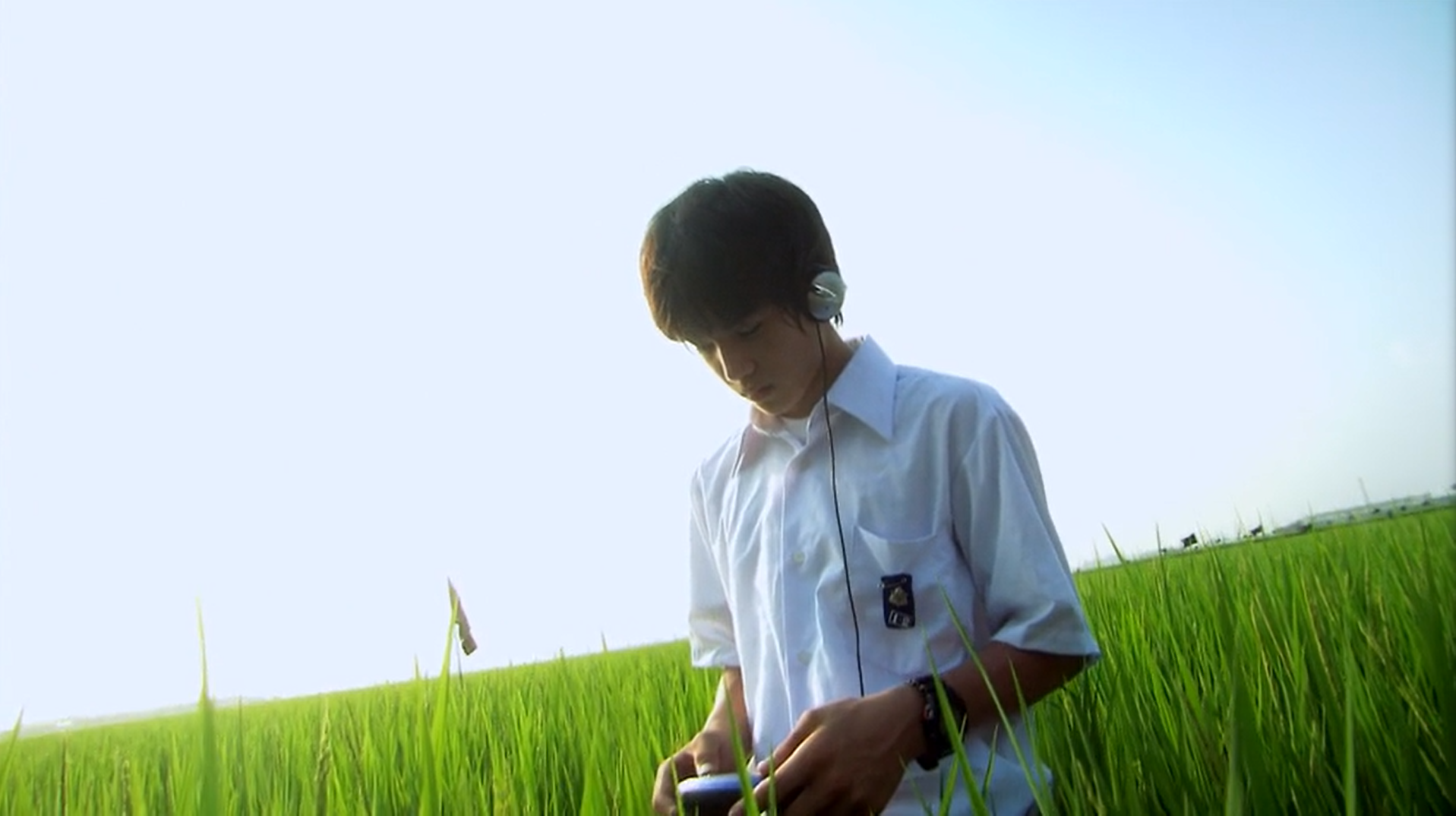
This opening line, from the user philia, opens a wound through empty space. Airy chimes combine with the soft female voice of Lily Chou-Chou as a saturated green field of grass appears. The sky is piercing white here. The camera tilts back and forth, growing closer to a young boy with Sony headphones, transfixed on music from his Walkman. This is Yūichi; this is also philia, a middle schooler who runs the ‘Lilyholic’ chat room. More conversations from other users appear. One user writes,
Liberating our thoughts…
for that reason, SHE IS.
The shadows SHE releases into the Ether
sublimate its wavelengths,
transcend the spectrum,
reach the transparent beyond.
A permeating image of pain
fills the gaps of serotonin.
Others silently chime in, echoing that the Ether eases their pain and that the Ether is a place of peace. In these conversations, they debate the special qualities of Lily Chou-Chou that make her unique amongst the backdrop of a boy listening intently. From how these people talk about Lily Chou-Chou, she sounds like a goddess. She is something to worship, she gives form to the world, she creates the space, the Ether, through which memories, moments, emotions flow from one person into and out of others, who resonate and respond like tuning forks. Her music holds real power; one that is both precious and fear-inducing.
When I was a teen, my Lily Chou-Chou was Sigur Rós.
In many ways, the two artists share the same ethereal sound. They sculpt a world through their voices, their lyrics. There’s something mysterious in their instrumentation; the choice of chimes crossed with unnatural guitar riffs makes songs feel unfamiliar and unplaceable. During the internet’s growing pains, I stumbled upon a site where you could create a playlist of songs that could be transferred onto your own blog. That’s where I heard Starálfur. That’s when I felt it. The Ether.
All About Lily Chou-Chou deftly captures this tenuous relationship we have to music. It’s not a crutch for adolescent angst, even though we may cringe at the songs we once thought were deep. These songs understand us. They ask nothing from us, other than to listen. They are, in many ways, a way to reconnect with our inner selves and reimagine personal hopes, desires, and fears into a more universal human experience. We are a singular person whom no one but music understands. At the same time, we are part of a collective who shares this connection to music, even if the nuances differ. Music has the ability to free us.
Iwai eagerly shows us how tethered we are to music. In one scene, Yūichi lays in bed, bathed in green light and stares at the ceiling as Lily Chou-Chou’s song, Experiment of Love plays. The song is muffled when he receives a phone call from Hoshino, an old friend now turned school bully. Hoshino invites Yūichi outside to an old scrap yard, where the music is now completely absent. Hoshino accuses him of ratting out the gang and the boys take turns beating Yūichi. More white-lettered comments from philia emerge onto the screen. We hear her voice again.
His posts hint towards his username; a callback to Lily Chou-Chou’s first song from the band, Philia. In between these posts, a green-yellow spotlight swings back and forth over bodies swinging, kicking, shouting. Despite the violence, we feel something protective in the soft vocals hovering over rippling guitar riffs and clattering drums. She sings, “I’m in you. You’re in me. You’re in me. I’m in you.”
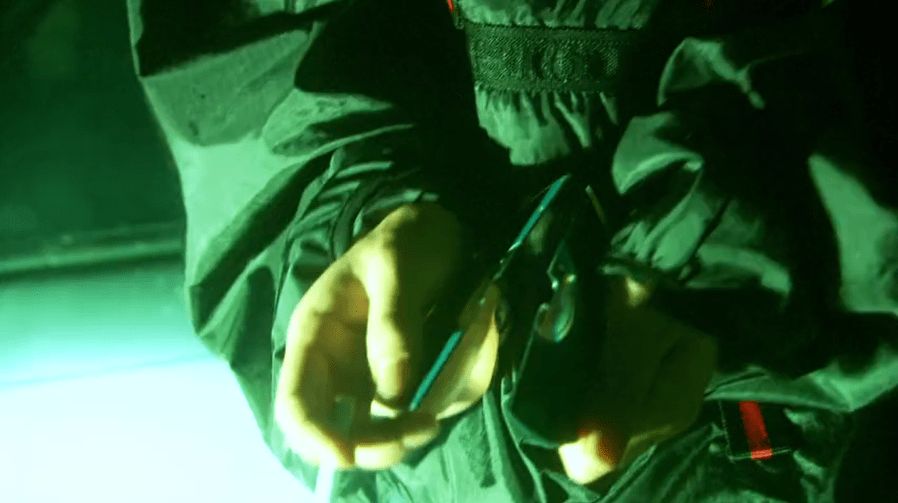
A CD with a broken cover lays on the ground. Hoshino picks it up with a cigarette in his hand. A moment passes, and he snaps the CD. The music stops.
Lily Chou-Chou’s songs alone cannot stop the beating. For Yūichi, she is but a weathervane rerouting coursing emotion, a placeholder for deep sentimentality that can momentarily transgress reality. However, for the audience, she facilitates the oscillation between the external world of late 90s Japan and the interiority of her devoted fans. Her music opens the Ether, allowing us to tacitly grasp Yūichi’s perspective without direct exposition.
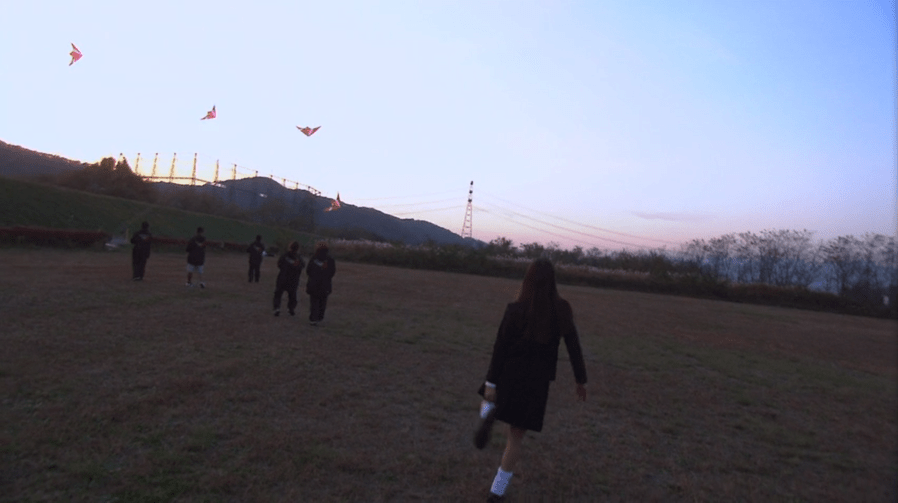
Iwai employs a similar tactic following Shiori Tsuda, a classmate who Hoshino blackmails into prostitution with older men. She is introduced to Lily Chou-Chou through Yūichi, who is tasked by Hoshino to supervise her. In a later part of the movie, the song, Wings That Can’t Fly, quietly plays in the background. It emerges in full breadth as kites fill the blue air, their red and white wings in vivid contrast. As they maneuver in a sharp dance, Shiori, in her school uniform, runs down to observe with immense fascination. As she tries using the kite, a huge grin emerges on her face. It swiftly crashes and we see the field, framed by transmission towers.
Lily Chou-Chou sings,
“Now that my wings can no longer fly
I’ll cast them off and when I do
I’ll walk on air and soar in the sky”
As if hearing the song as it slowly fades, Shiori says to no one in particular, “I wanna fly through the sky.”
The next shot is from above, slowly growing closer to her body, face down in the ground next to a tower. She has ended her own life. Her cellphone adorned with charms is caught on the wire, and dangles like flowers above her.
These scenes are precarious but are highly impactful. There is at once, a deep desire for music to encapsulate life, especially fundamental life events. Think to yourself: throughout the years, you’ve had songs you like that stuck. They’re like mantras that come to you in times of need. They anchor you, make you feel something, an emotion, so radical and freeform. They offer a possibility of dialogue with oneself that can also be quickly taken away. At the same time, music envelops the moment. When time has passed and the memory becomes loose, a song can light up our hearts, and encourage us to root within our feelings. We know this for ourselves as we experience the melody, but outwardly expressing the power of music is more tenuous.
When I heard Starálfur, I was bullied in school. My outlet was the internet, and I wanted to make my blog look the way I wished the real me could be. Beautiful. Popular. Interesting. Back then, we would encode a song track so that it would play while users browsed your site. That’s how they, those faceless users with grayed out boxes got to know you. Trying to find the perfect song for my blog, I stumbled onto it. It was tucked away in an unknown user’s playlist. I didn’t know what it was, the name was foreign and seemingly unpronounceable, but I clicked it.
There was static. Droning, industrial-like violins, suddenly giving way to a bubbly piano. The singer’s voice, an ethereal falsetto, pierced the air. Mid-way through the song, most of the instruments fell away. Only the voice and guitar were left. The track closed off, creating immediate intimacy. Then, the fuse was lit. The drums came down like lush fireworks. It rattled my chest. The trumpets and violins joined too, until there was a chaos of sound, climaxing further and further still. It seemed like there was the possibility of hope overflowing the world. At the same time, the effervescence of sound was fragile enough that it seemed on the precipice of bursting. I felt joy and sadness as if bittersweet was a harmony. I emerged from its surface. Had I been holding my breath? Something had changed in me.
I didn’t know who Sigur Rós was. I also didn’t know how to find more music like them. All I could do was listen to this song on loop for weeks. Until I felt like it seeped into my bones. Until I could hear it in every moment like the breeze.
That’s when I found the Ether. Or, at least, my own version of it. These songs and voices muffled the noise of everyday life. They created spaces of feeling, a sense of acceptance and belonging that transcended my body. I felt, for the first time, someone completely understood me. That faceless voice, the instruments, the person who shared this song. Everything I had lived up to this moment coalesced together. Here, in this profane space, I found myself.
Yūichi, Honshino, and Shiori also found the Ether. However, nothing shows this as powerfully as the closing credits. Like the beginning of the movie, Yūichi is in the green field, holding his Walkman near his side. Time is more fluid in this scene, jumping between seasons. The song, Glide, plays. This is the only fully English song in the soundtrack. User comments appear overtop of the characters, explaining the impact Lily Chou-Chou’s music has on them. After some time, the scenery switches to one of early morning. The grass is shorter and the tips are yellow in the sunlight. Shiori clutches the Walkman close to her, listening without moving. Again, the scene changes to reveal Hoshino in a barren field at sunset. He stands in a stupor, staring at the ground. Throughout this overlapping scene, we’re immersed in the Ether of Lily Chou-Chou’s songs, the meaning and power it has over these characters. We grasp the music’s interiority, even if we aren’t truly privy to the character’s thoughts and feelings.
We’re also incorporated into the Ether. We feel an emotional attachment to these characters whose lives are unlike our own. We hear the song and think–feel–the same things. That’s the beauty of Lily Chou-Chou.
The final user comment writes,
Maybe I’m writing this
Because i want to scream out
“I’m here!”
At the same time, Lily Chou-Chou softly sings,
“I wanna be just like a melody
Just like a simple sound
Like in harmony”
After all these years, I don’t listen to Sigur Rós so much anymore. Their place and importance in my heart has been given to new musicians with new stories that echo more closely my current self. Still, I find my way back to their songs. A sense of calm washes over me. The sadness and pity I felt all those years ago lingers like a scar, but the track continues. The Ether opens up and takes me as I am.
Works Cited
All About Lily Chou-Chou. Directed by Shunji Iwai, Produced by Koko Maeda. 2001.
 Short Ends