
When was the first time you encountered a spirit? Mine was many years ago. I remember one night when my mom made dinner for an extra person. Before she sat down, my mom took out a small china plate from the cabinet. Arranging a scoop of white rice in its center, she topped it with chicken adobo. The meal was placed at an empty spot at the table; four people, five plates.
It sat undisturbed for some time. As we finished our food and went for seconds, the chicken and rice were still untouched. When I went to pick it up and bring it to the sink, my mom stopped me. She said, “Leave it there. It’s an offering for your uncle.”
Days passed. Before it could bloom with a million microorganisms, the food was replaced. She made another bowl of rice, and roasted another drumstick. A new plateful of food returned to its auspicious corner with an empty chair. Sitting alone again, it filled the room with a dense silence. This was a feast for ghosts. A dinner with family.
There is a certain ambiguity in this memory. An element of this story is missing or omitted; it’s kept at arm’s length. I never asked my mother more about this moment and we never spoke of it again. Perhaps she was guarded or secretive about what it meant. I think in my own explanation, I’ve also got something to hide. What lurks in what’s unsaid? What resists acknowledgment?
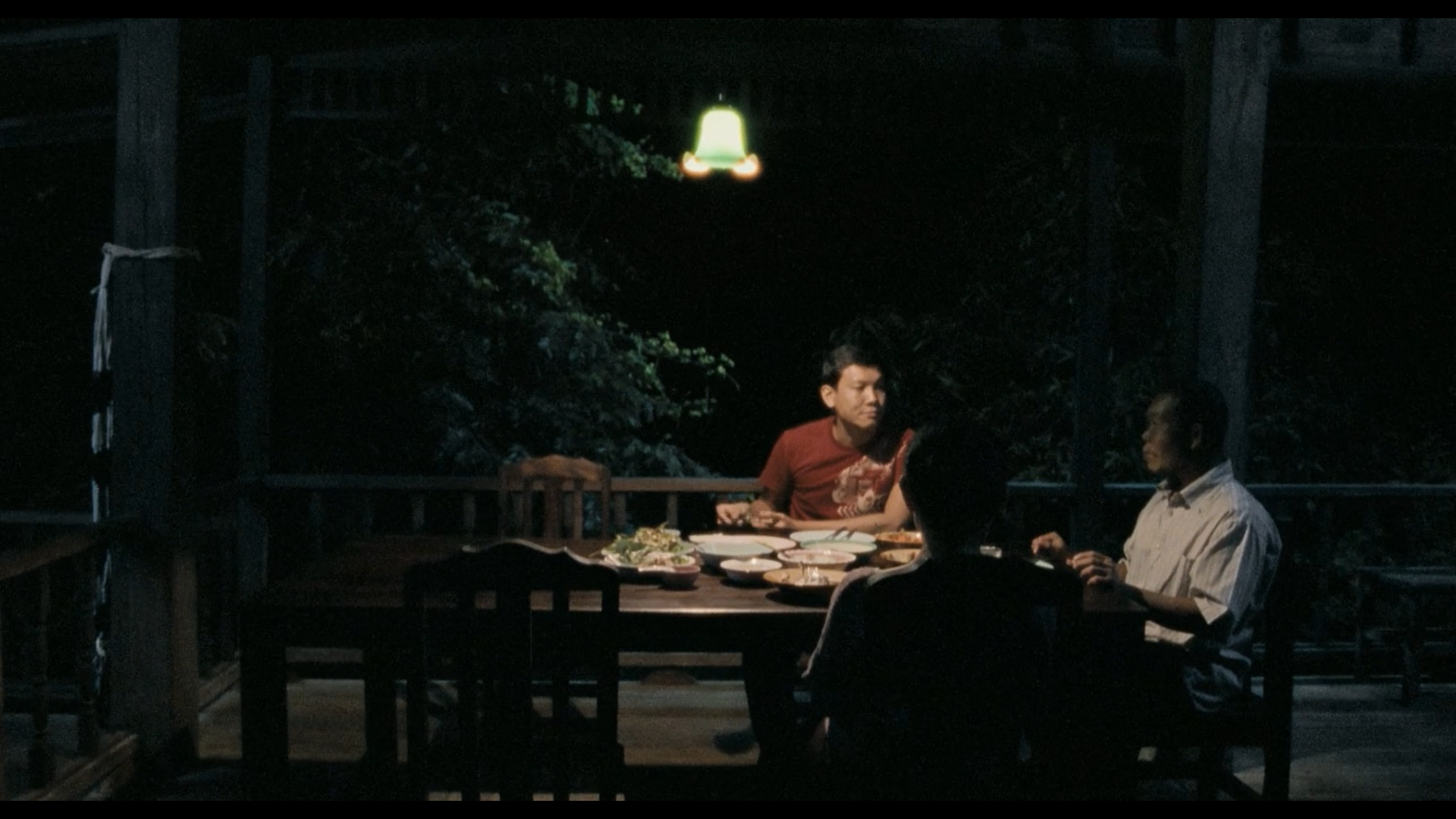
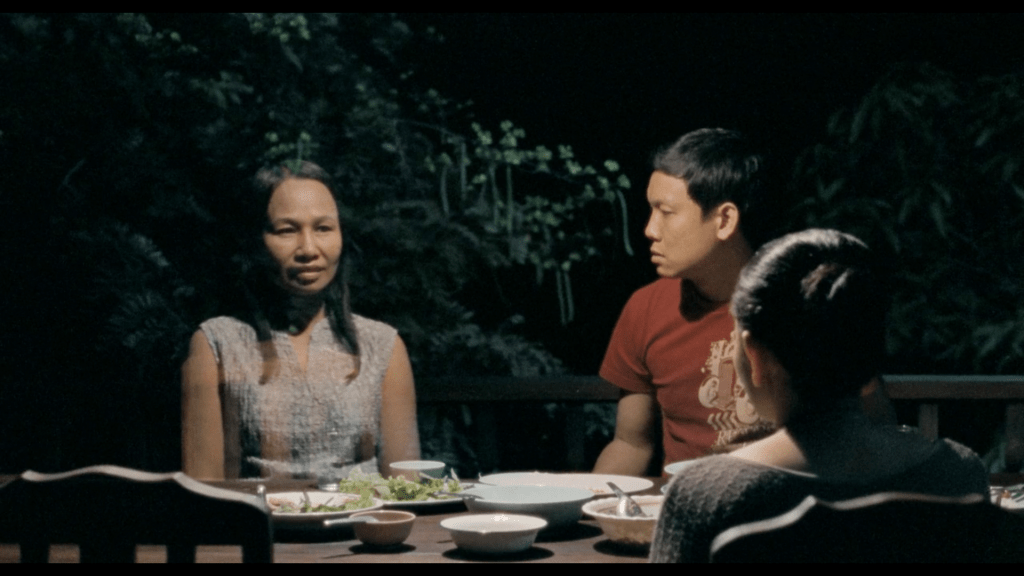
Spirits are ambiguous in many stories. My own tale bears some similarity to a scene in Apichatpong Weerasethakul’s masterful work, Uncle Boonmee Who Can Recall His Past Lives (2010). In this film, the titular character navigates his own uncertainty facing illness and death via the encounters he has with the nonhuman world. In a quiet moment, Boonmee shares a meal with his sister-in-law, Jen, and her son. Their dinner is illuminated by one green lamp hanging from the ceiling, allowing the night to creep from the forest onto the table and chairs. As they talk amongst themselves, a woman gradually manifests in an empty seat, filling up space until she is almost completely opaque. This is Huay, Boonmee’s long-dead wife. While there is a sense of uneasiness in the humans at the table, they don’t act in fear or disbelief. After some brief chat, Jen says, “Huay, did you get the things I sent you via the temple?”

Huay smiles and answers, “Yes sister. Thank you very much. I could feel them. I could hear your prayers. It comforted me on those cold nights with only the whispering wind. I heard familiar voices. Boonmee’s voice… perhaps… they were being replayed from my dying consciousness.”
Boonmee isn’t afraid of his wife’s spectral presence. Even though he asks her if she’s here to take him away, she doesn’t offer an answer. Later, she tends to his stomach while he’s connected to his dialysis machine. As they embrace each other, Boonmee asks, “I don’t know how I’ll find you after I’m dead. Where should my spirit go look for you?”

She tells Boonmee, “Ghosts aren’t attached to places, but people, to the living.”
In juxtaposition, much of western folklore’s ghosts are bound to old creaky houses, cemeteries, dark and dimly lit buildings decrepit and forgotten with time. People have reported hearing cries from wounded soldiers who died at Gettysburg during the American Civil War. A family moves into a Victorian house and is plagued with the malevolent ghosts that were massacred in their kitchen years prior. There’s little to no social relationship between the ghost and the haunted, other than both occupying the same place. Even more venerable and heavenly apparitions such as the Virgin Mary are tied to contained areas; devout Catholics set out on pilgrimages to Notre-Dame-du-Cap shrine in Quebec where they can witness the spirit, ask for help, and give thanks. Conversely, the ghosts of loved ones don’t linger. They appear to reassure us of their love, health, and safety post-death, and disappear once we’ve accepted their message.
Outside of these popular Western discourses, spirits can occupy a less ephemeral and more social role in facilitating relationships and lineages. It’s not uncommon in South East Asian societies that these beings are part of a lineage of ancestor worship facilitated by their living, human counterparts. Weerasethakul shows this in his film by exploring the familiarity that people speak of–and interact with–the dead from a Thai perspective. Jen leaves gifts at the temple for her sister in order to reaffirm their sisterly bond. Later on, Boonmee grabs a photo album to show his wife pictures of his farm and how it’s changed since she’s been gone. More broadly, the living care for the non-living (or nonhuman) through cleaning their tombstones, spending time at gravesites, or providing offerings like food. In turn, these spirits watch over the living and provide guidance. This relationship of responsibility and indebtedness to kin is circular.
Unlike Boonmee, who is cared for by his dead wife, my kinships are much more strained and uncertain. I don’t recognize the ghosts who come to haunt me. Perhaps if I were not within the Filipino diaspora, my relationships with them would be different. Maybe then I’d be able to welcome them in without hesitation, even if I couldn’t count the degrees of separation. Yet, these spirits must know me. They choose to visit me halfway across the world. It’s not an accident that they’re here, occupying my kitchen or whispering in my ear. I start to dream of all the people I could have known and what they must think of me now, the white-skinned stranger. They’ve traveled so far. I should be more gracious.
In the humid summers, when sweating is no longer kept at bay by antiperspirant, I meet an ancestor who chides me for wearing water-wicking Lululemon shirts. In my dreams, she says things like, “Your body isn’t meant to wear these clothes. Try piña instead,” and ushers me into a room draped with embroidery, white camisas delicately blooming with flowers I have never known. “Listen to your Tita. We share the same freckles.”
Other times, a ghost stops by for a snack while they’re on their way to the spirit world. My uncle, who died of liver failure over Christmas, mourns the beer selection in Cebu. He’s probably been wandering around the world, stopping in with distant relatives for a little taste of local cuisine. Even if he barely knows me, over the last few days, I find my bottle one sip short. Double IPAs are not to his taste, it seems.
In the diaspora, responsibility and indebtedness also extend to the present—not towards the locale in which they reside, but towards those who migrants leave behind. There’s an expectation that the diaspora must give back to the homeland. After all, few leave the islands without assistance. One form of giving is through remittances such as money to buy things like farming equipment or an air conditioner. Boxes are also filled with canned goods and non-perishables which are then mailed and shipped across the world. Although we are absent just as our ghostly ancestors, we can still make an impact from afar. In turn, a part of my own world is haunted by the presence of the Philippines.
When my mom calls, we talk about the super typhoon that hit the Philippines. Grandma’s lucky because she still has a roof on her house. There’s no electricity though; we should look for a diesel-powered generator to mail her. I comb through stores for machines with the right voltage but no one has what I’m looking for. As I pause at the exit of yet another hardware store, I catch a glimpse of my grandmother’s island in the storefront window. The snow around my feet is thick, brown water while palm trees lattice across the road. Montrealers pierce through the mirage. They don’t stop to clear the fragments of tin roofs or telephone poles. Speaking to my mom again, I tell her my search came up empty. She says, “Don’t worry about it. The roads are full of debris anyway.”
In my uneasy relationship with spirits, I recognize a premise at its very core: those who live on have the responsibility to their own kin, past and present. We’re all tangled in tenuous and obscure histories that are trying to escape extinction. Jacques Derrida writes, “There is no inheritance without a call to responsibility. An inheritance is always the reaffirmation of a debt, but a collective, selective, and filtering reaffirmation.” (Derrida 114). This is the reality for many in the diaspora who maintain their relationship with the homeland. While spirits are simply one aspect of this relationship, we are nonetheless responsible in the face of the presence of the absent. That’s why it’s nearly impossible to say no to the ghost of an uncle, even if he’s two times removed. These spectral relationships represent the debt incurred for living—and sometimes, living well—in the diaspora. Visits from the homeland are thus a gentle reminder that ties that become tenuous and fractured by distance can also be reinforced by conjuring in their absence.
Unfortunately, while spirits play a crucial role in maintaining relationships across time and space, the discourse surrounding them in the West is highly informed by colonialism and its second face, capitalism. One of its most violent practices is to continually attempt to erase the mystical, spiritual life of the Other. This is done through the process of modernity; a rationalization and intellectualization of how we live our lives. Hard science proves that spirits don’t exist. Food on the table rots as the only things that eat it are bugs, mold, and fungi. This is how I grew up to think. This is also what shapes my hesitation in sharing with you my own spiritual life. Modernity disenchants our world, pushing the spiritual and sublime out of public life (Weber 155). It coaxes the diasporic to reject culture and tradition in favour of a singular, sanitized, and logical world. The severity of this process is doubly amplified for the marginalized, whose faces, stories, and cultures cannot (and don’t want to be) reconciled with their destruction. Modernity doesn’t care that spirits are ancestors—family—that deserve honour and respect.
But the otherworldly still persists, even if capitalism portrays itself as wholly secular and rational. Weber famously illustrates that Western capitalism is a religion by showing its indebtedness to Protestant ethics. Walter Benjamin takes this argument further by revealing capitalism’s indistinguishability from Christianity. He explains, “Capitalism has developed as a parasite of Christianity in the West […], until it reached the point where Christianity’s history is essentially that of its parasite–that is to say, of capitalism” (Benjamin 289). Both systems of belief share the same practical ideals and moral interests of dominating the Other. If you or your spirits don’t already exist within a Christian framework, capitalism will stomp it out. That’s why the spirit of an uncle or wife who visits at dinnertime is oftentimes incomprehensible or unrecognizable within a Western framework of spirits. There is little to no room for this configuration of family or ancestor worship in a world selling itself as rational.
However, all is not lost. Robert Desjarlais writes that Western philosophers such as Derrida have explored the interrelationship of the real and unreal in order to bridge this gap. He writes, “In learning how to live, and live on (sur-vivre), [Derrida] took it upon himself to learn how to live with ghosts (fantômes, in French).” (157). This concept isn’t new for the colonized. Learning how to live and to live on is a tactic of survival in the diaspora. When you are across the world from your homeland, your family, and your culture, there’s little else to do. You must learn to live on. The specters of the dead—as well as the spirits of the living—will find their way to you.
Maintaining a relationship with spirits is a form of resistance against modernity. It allows us to strengthen ties to our own culture. Weerasethakul’s film also shows that enchanting our world can help create more meaningful and fulfilling relationships with family, near and far, living and dead. With great tenderness, Huay tells Boonmee, “Ghosts aren’t attached to places, but to people, to the living”. The living honour spirits by offering them a place at the table. At the same time, our ancestors honour us in return; we’re worth visiting. Within us is the possibility to create a better world for our kin, past, present, and future. And when we too will eventually come to visit our own family, hopefully, there will be someone to serve us dinner.

Works Cited
Benjamin, Walter. “Capitalism as Religion in Selected Writings 1: 1913-1926”. Marcus Bullock and Michael W. Jennings eds. Pp. 288-291. The Belknap Press of Harvard University Press: Cambridge (Mass). 1996.
Desjarlais, Robert. The Blind Man – A Phantasmography. Fordham University Press. 2019.
Weber, Max. “Science as Vocation”. In From Max Weber: Essays in Sociology. H.H. Gerth and C.W. Mills, eds. Pp. 129-156. Oxon: Routledge. 1948.
Weerasethakul, Apichatpong. Uncle Boonmee Who Can Recall His Past Lives. 2010.
 Short Ends